
Opening Hours Practical Info What is where? Apps Public Tours further language offers Accessibility FAQ

buchenwald 1945.

On 11 April 1945, U.S. Army units forced the SS to retreat, after which prisoners in the camp resistance assumed control of the camp. Twenty-one thousand men and boys were liberated on the Ettersberg that day. Yet, what happened in the days, weeks and months following liberation? This exhibition highlights the central events that took place in the liberated camp between mid-April and early July 1945, and sometimes later, using historical photographs, many of which are on public display for the first time. These images are complemented by reports from people who experienced Buchenwald in the spring of 1945, including survivors, members of the U.S. Army and visitors to the camp. The exhibition consists of twelve columns situated at locations on the memorial grounds where the scenes depicted on the main side actually took place.

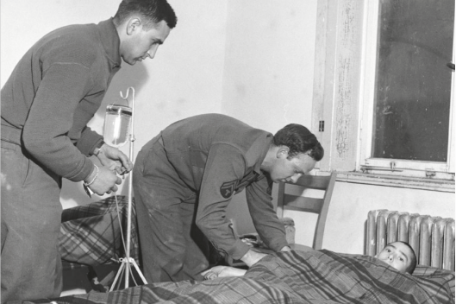
The image depicts a scene in a medical or emergency care setting. Two men in uniform are attending to a patient lying under a checkered blanket. The man on the right is leaning over the patient, seemingly checking vital signs or providing assistance, while the man on the left is preparing an intravenous drip. In the background, there is a window with an old frame, and below it, a radiator is visible. The setting appears simple and functional, possibly in a military or emergency response context. The posture of the two men suggests that they are providing professional and attentive care to the patient.

SAVING LIVES Former SS barracks


The American journalist Percy Knauth describes the immediate medical measures taken after liberation:

“They lay there quietly, their dark eyes fixed on the ceiling as the soothing heat went into them; what they were thinking God...

Read more
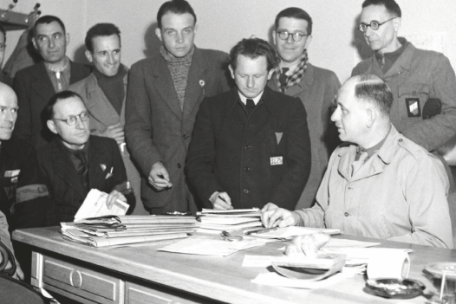
Der kurzzeitige amerikanische Lagerkommandant Major Lorenz C. Schmuhl (rechts, sitzend) im Gespräch mit Vertretern des Internationalen Lagerkomitees (u.a. Vierter von rechts der ehemalige deutsche Häftling Walter Bartel, daneben der Franzose Maurice Jattefaux), um den 24. April 1945.

MANAGING THE CAMP Former camp commandant's office

The French liaison officer Sonia Vagliano describes the co-operation between Schmuhl’s successor, the American camp commander Captain Peter Ball, and the International Camp Committee:
“The internal administration of Buchenwald turns out to be...

Read more
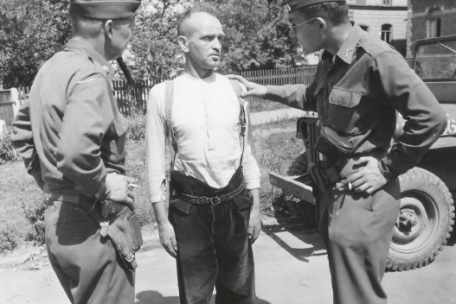
Zwei Offiziere des amerikanischen War Crimes Investigating Teams 6822 verhören einen SS-Mann in Berga / Elster, 8. Juni 1945. Der Verhaftete gehörte zur Wachmannschaft der Lager in Berga / Elster, einem Außenlagerstandort des KZ Buchenwald. Foto: Robert H. Wescott

CONFRONTING THE PERPETRATORS Outside the camp prison

The Frenchman Michel Julien describes the SS men who were captured by liberated prisoners and detained in Block 17, the former quarantine block:
“I walk past Block 17, the transit block [...]. Captured SS men walk back and forth behind the barbed...

Read more
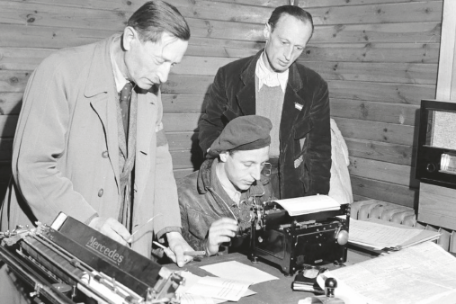
Ehemalige Häftlinge bei der Arbeit im Pressebüro im Obergeschoss des Torgebäudes, um den 24. April 1945. Von links nach rechts: Lev Sychrava, Ladislav Žižka (beide Tschechoslowakei) und Gustav Herzog (Österreich). Das Pressebüro war auf Anregung der Presse- und Informationsabteilung des Internationalen Lagerkomitees eingerichtet worden. Sein Zweck war es, Journalisten vor Ort zu begleiten und mit vorbereiteten Informationen zu versorgen. Foto: Thérèse Bonney

REPORTING FROM BUCHENWALD In front of the camp gate

Walter Bartel, a German survivor and member of the International Camp Committee, describes the Committee’s press work after liberation:
“After the Americans marched into the camp, there was an invasion of correspondents from every country, radio...

Read more
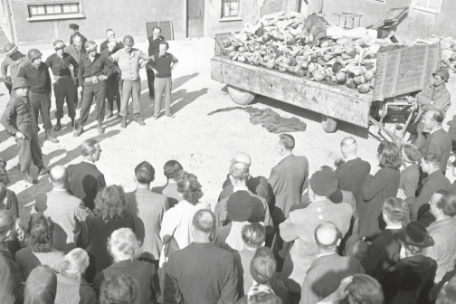
Überlebende und US-Soldaten zeigen Frauen und Männern aus Weimar die Leichen verstorbener Häftlinge im westlichen Innenhof des Krematoriums, 16. April 1945. Foto: Walter Chichersky (U.S. Signal Corps)

CONFRONTING THE POPULATION In front of the crematorium courtyard

The Spanish survivor Jorge Semprún describes the Weimar residents’ visit to the crematorium:
“In the crematory yard that day, at any rate, an American lieutenant addressed the several dozen women, adolescents of both sexes, and elderly German men...

Read more
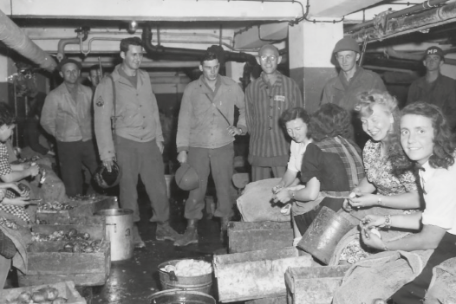
Frauen aus Weimar beim Kartoffelschälen im Keller der ehemaligen Häftlingsküche, 27. Mai 1945. Im Hintergrund der deutsche Überlebende Ernst Neujahr und amerikanische Soldaten. Foto: Charles W. Herr Jr. (U.S. Signal Corps)

WORKING IN THE LIBERATED CAMP at the cellar of the prisoners' kitchen

Clinton C. Gardner, acting American camp commander from May to early July 1945, describes the deployment of Weimar residents in the liberated camp according to orders from the U.S. Army:
“My first job was the cleaning of the camp, removal of all...

Read more
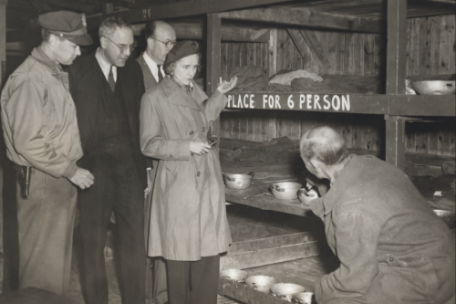
Amerikanische Kongressabgeordnete, darunter Clare Booth Luce aus Connecticut, im Gespräch mit einem Überlebenden vor den Schlafboxen einer Baracke im Kleinen Lager (vermutlich Block 61), 21. April 1945. Die Baracke war nach der Befreiung geräumt und mit Objekten und erklärenden Beschriftungen eingerichtet worden. Foto: Byron H. Rollins

PRESENTING EVIDENCE At Block 61, the ‘death block’

The American Congresswoman Clare Booth Luce speaks about her visit to Buchenwald:
“In the days to come, many Germans and perhaps some of the people of the Allied countries will arise to say that accounts of Nazi atrocities were either greatly...

Read more
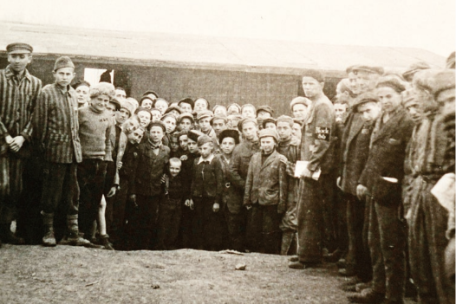
Befreite Kinder und Jugendliche vor dem sogenannten Kinderblock 66 im Kleinen Lager, nach dem 11. April 1945. Nach der Befreiung brachte man die Kinder und Jugendlichen in den SS-Kasernen oberhalb des Steinbruchs unter. Fotograf unbekannt

HELPING THE CHILDREN At block 66, the ‘children's block’

The British journalist George Fyfe describes meeting the liberated children and adolescents:
“But an even more pathetic sight was that of 900 boys under 14 of many nationalities. They came in with fathers who are now dead or missing through...

Read more
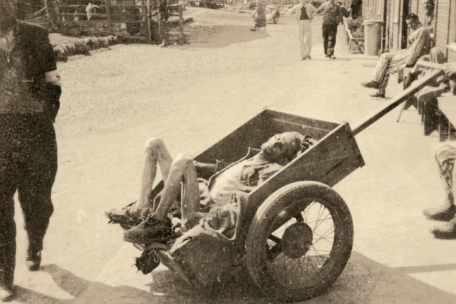
Verstorbener Häftling in einem Handkarren vor der Baracke 1 des Häftlingskrankenbaus, 16. April 1945. Der Leichnam wurde wahrscheinlich in den Hof des Krematoriums gebracht, wo die Toten vor der Beerdigung gesammelt wurden. Fotograf unbekannt

DYING At the inmates' infirmary

Rolf Weinstock, a Jewish survivor from Emmendingen near Freiburg, describes the people dying in the liberated camp:
“All the necessary medicine and urgently needed bandages were brought in right away to reduce the death rate as quickly as possible....

Read more
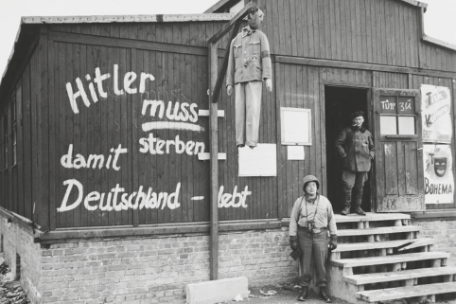
Eine von Überlebenden an einem Galgen aufgehängte Hitlerpuppe an einer der Baracken der optischen Werkstätten am Rande des Appellplatzes, Mitte April 1945 oder später. Daneben die aufgemalte Losung „Hitler muss sterben, damit Deutschland lebt“. Fotograf unbekannt

THINKING ABOUT THE FUTURE Below the inmate canteen

Excerpt from the “Manifesto of the Democratic Socialists of the former Buchenwald Concentration Camp” (“Buchenwald Manifesto”), written a few days after liberation:
“As long as fascism and militarism have not been completely destroyed in Germany,...

Read more
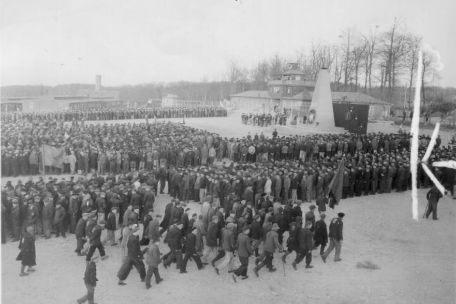
Liberated prisoners at the first memorial service for the dead of Buchenwald concentration camp. The temporary memorial for the dead can be seen in the background.

COMMEMORATING THE DEAD On the roll call square

The French survivor André Respaut describes the memorial service on 19 April 1945:
“The comrades worked all day on a memorial. We head to the roll call square where the memorial service for the 51,000 dead of Buchenwald is being held. The national...

Read more
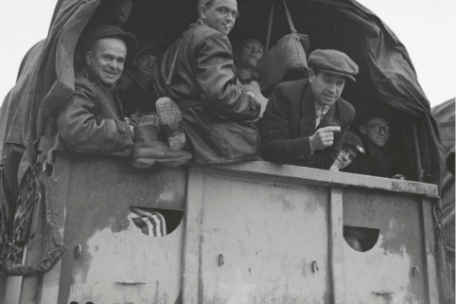
Eine Gruppe Überlebender, vermutlich Franzosen, vor der Abreise auf dem Appellplatz, um den 24. April 1945. Eine erste Gruppe französischer Überlebender hatte Buchenwald bereits eine Woche nach der Befreiung verlassen. Sie waren die ersten offiziell Repatriierten. Foto: Thérèse Bonney

LEAVING THE CAMP Above the former barracks

The Frenchman Jean Puissant describes the moment of his departure from Buchenwald:
“The next evening, 20 April 1945, as we were preparing a hearty meal in our charming little room, the sound of engines under our windows, squealing brakes, shouting,...

Read more

Exhibition team

Maëlle Lepitre, Michael Löffelsender

Holm Kirsten, Rikola-Gunnar Lüttgenau

Translation

Miriamne Fields

Editing

Katharina Brand, Marie Frohling

Design

werkraum_media, Weimar

Columns

Trend Schrift & Werbung Weimar

Website

Alexander John Bolton

Special thanks to

Association Française Buchenwald Dora et Kommandos (Jean-Luc Ruga), Thomas and Caroline Heller, Juliet Sychrava, Manuel Fabritz

Funded by

The Buchenwald and Mittelbau-Dora Memorials Foundation is funded by the Federal Government Commissioner for Culture and the Media on the basis of a resolution of the German Bundestag and by the Thuringian Ministry of Education, Science and Culture.


var _paq = window._paq = window._paq || []; /* tracker methods like "setCustomDimension" should be called before "trackPageView" */ _paq.push(['trackPageView']); _paq.push(['enableLinkTracking']); (function() { var u="https://matomo.buchenwald.de/"; _paq.push(['setTrackerUrl', u+'matomo.php']); _paq.push(['setSiteId', '1']); var d=document, g=d.createElement('script'), s=d.getElementsByTagName('script')[0]; g.async=true; g.src=u+'matomo.js'; s.parentNode.insertBefore(g,s); })();