Opening Hours Practical Info What is where? Apps Public Tours further language offers Accessibility FAQ

CONFRONTING THE POPULATION

Überlebende und US-Soldaten zeigen Frauen und Männern aus Weimar die Leichen verstorbener Häftlinge im westlichen Innenhof des Krematoriums, 16. April 1945. Foto: Walter Chichersky (U.S. Signal Corps)
In the western courtyard of the crematorium, survivors and US soldiers show residents of Weimar the bodies of dead prisoners, 16 April 1945. Photo: Walter Chichersky (U.S. Signal Corps) ©National Archives at College Park, Maryland

The Spanish survivor Jorge Semprún describes the Weimar residents’ visit to the crematorium:


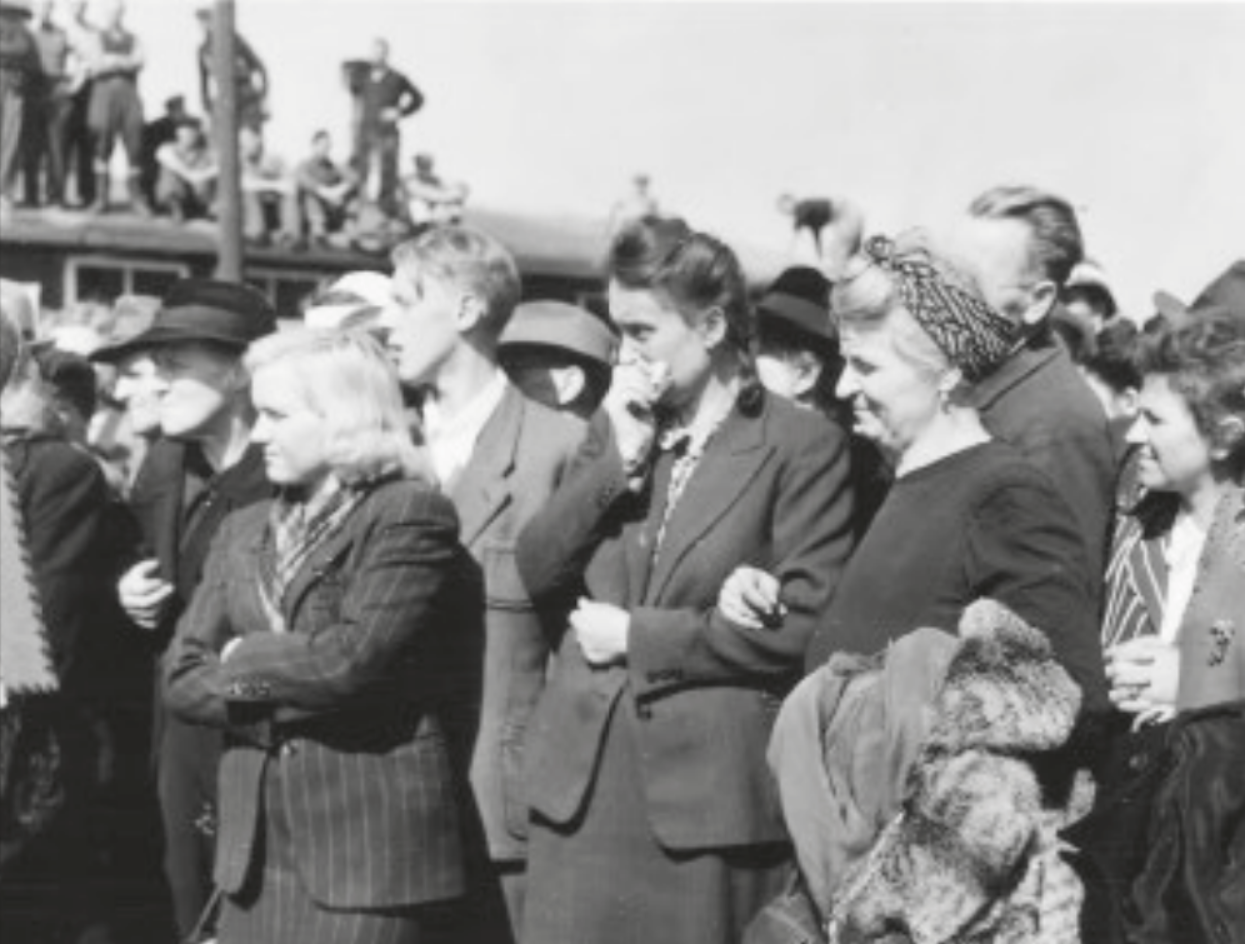
“In the crematory yard that day, at any rate, an American lieutenant addressed the several dozen women, adolescents of both sexes, and elderly German men from the city of Weimar. The women were wearing spring dresses in bright colors. The officer spoke in a neutral, implacable voice. He explained how the crematory oven worked, gave the mortality figures for Buchenwald. […] The women (a good number of them, at least) were unable to restrain their tears and begged for forgiveness with theatrical gestures. Some of them obligingly went so far as to feel quite faint. The adolescents took refuge in despairing silence. The old men looked away, clearly unwilling to listen to any of this.”

Jorge Semprún, Literature or Life, New York 1997 [Paris 1994]

Frauen und Männer aus Weimar im Verbrennungsraum des Krematoriums, 16. April 1945. Foto: Walter Chichersky (U.S. Signal Corps)
1/6
Residents of Weimar in the incinerator room of the crematorium, 16 April 1945. Photo: Walter Chichersky (U.S. Signal Corps) ©National Archives at College Park, Maryland
Weimarer und Weimarerinnen vor dem Galgen mit einer Häftlingspuppe im östlichen Innenhof des Krematoriums, daneben ein Tisch mit Urnen, 16. April 1945. Zur Lagerbesichtigung wurden ausdrücklich Männer und Frauen aus allen sozialen Schichten und vor allem Mitglieder der NSDAP aufgefordert. Foto: Walter Chichersky (U.S. Signal Corps)
2/6
Residents of Weimar stand in the eastern inner courtyard of the crematorium, looking at a prisoner dummy hanging from a gallows. Next to the group stands a table with urns, 16 April 1945. Men and women from all social classes and, in particular members of the Nazi Party, were explicitly summoned to visit the camp. Photo: Walter Chichersky (U.S. Signal Corps) ©National Archives at College Park, Maryland
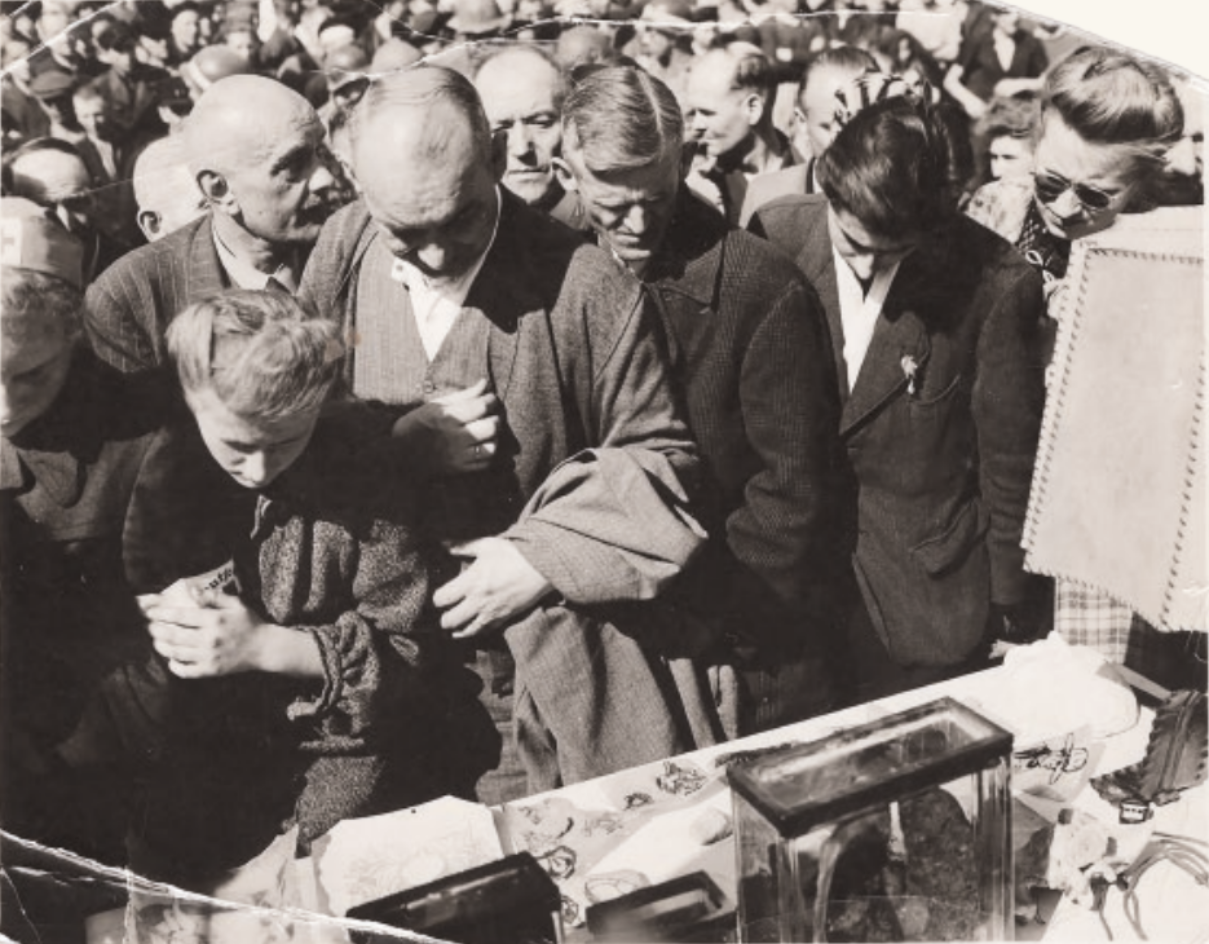
Männer und Frauen aus Weimar vor einem Tisch mit menschlichen Präparaten und tätowierter Menschenhaut, 16. April 1945. Die gezeigten Objekte hatte die SS in der Pathologie des Lagers anfertigen lassen. Fotograf unbekannt
3/6
Residents of Weimar in front of a table with human remains and tattooed human skin, 16 April 1945. The presented objects were prepared by the SS in the camp’s pathology department. Unknown photographer ©United States Holocaust Memorial Museum
Weimarer und Weimarerinnen im Innenhof des Krematoriums, 16. April 1945. Der Rundgang führte auch in die Baracken des Kleinen Lagers. Foto: Walter Chichersky (U.S. Signal Corps)
4/6
Residents of Weimar in the inner courtyard of the crematorium, 16 April 1945. The tour also visited the barracks of the Little Camp. Photo: Walter Chichersky (U.S. Signal Corps) ©National Archives at College Park, Maryland
Einwohner und Einwohnerinnen aus Nammering in Niederbayern bei einer von der U.S. Army angeordneten Besichtigung der exhumierten Opfer eines Räumungstransportes aus Buchenwald, 17. Mai 1945. Foto: Howard E. James (U.S. Signal Corps)
5/6
Ordered by the U.S. Army, residents of Nammering in Lower Bavaria attend a viewing of exhumed victims from an evacuation transport from Buchenwald, 17 May 1945. Photo: Howard E. James (U.S. Signal Corps) ©National Archives at College Park, Maryland
Die Bevölkerung von Burgsteinfurt wird von britischen Militärangehörigen in das örtliche Kino geführt, um sich Aufnahmen aus den befreiten Konzentrationslagern Bergen-Belsen und Buchenwald anzuschauen, 30. Mai 1945. Auch abseits der Tatorte konfrontierten die Besatzungsbehörden die Bevölkerung mit den KZ-Verbrechen. Foto: Charles Stiggins (Royal Corps of Signals)
6/6
The residents of Burgsteinfurt are led into the local cinema by British military personnel to watch footage from the liberated Bergen-Belsen and Buchenwald concentration camps, 30 May 1945. The occupation authorities also forced Germans to confront the crimes at locations other than the camps. Photo: Charles Stiggins (Royal Corps of Signals) ©National Archives at College Park, Maryland

On 16 April 1945, the commander of the III U.S. Army, General George S. Patton, ordered more than 1,000 men and women from Weimar to visit Buchenwald. US soldiers and survivors led them through the camp and showed them the evidence of the crimes. A similar confrontation took place at the liberated Ohrdruf subcamp near Gotha and at many other crime sites. As in Weimar, the locals usually automatically denied any complicity in or responsibility for these crimes. After being confronted, they often deflected guilt.



var _paq = window._paq = window._paq || []; /* tracker methods like "setCustomDimension" should be called before "trackPageView" */ _paq.push(['trackPageView']); _paq.push(['enableLinkTracking']); (function() { var u="https://matomo.buchenwald.de/"; _paq.push(['setTrackerUrl', u+'matomo.php']); _paq.push(['setSiteId', '1']); var d=document, g=d.createElement('script'), s=d.getElementsByTagName('script')[0]; g.async=true; g.src=u+'matomo.js'; s.parentNode.insertBefore(g,s); })();