
Opening Hours Practical Info What is where? Apps Public Tours further language offers Accessibility FAQ

REPORTING FROM BUCHENWALD

Ehemalige Häftlinge bei der Arbeit im Pressebüro im Obergeschoss des Torgebäudes, um den 24. April 1945. Von links nach rechts: Lev Sychrava, Ladislav Žižka (beide Tschechoslowakei) und Gustav Herzog (Österreich). Das Pressebüro war auf Anregung der Presse- und Informationsabteilung des Internationalen Lagerkomitees eingerichtet worden. Sein Zweck war es, Journalisten vor Ort zu begleiten und mit vorbereiteten Informationen zu versorgen. Foto: Thérèse Bonney
Former prisoners at work in the press office on the upper floor of the gate building, around 24 April 1945. From left to right: Lev Sychrava, Ladislav Žižka (both from Czechoslovakia) and Gustav Herzog (Austria). The press office was set up at the suggestion of the press and information department of the International Camp Committee. Its purpose was to accompany journalists on the grounds and provide them with prepared information. Photo: Thérèse Bonney ©The Regents of the University of California, The Bancroft Library, University of California, Berkeley. This work is made available under a Creative Commons Attribution 4.0 license.

Walter Bartel, a German survivor and member of the International Camp Committee, describes the Committee’s press work after liberation:


“After the Americans marched into the camp, there was an invasion of correspondents from every country, radio reporters, photojournalists and other members of the press. They flooded the camp and interviewed every prisoner. Obviously, the individual inmate could only offer a very subjective picture of Buchenwald’s history. The International Camp Committee therefore commissioned its press and information department, which was run by Georg Krausz, former foreign editor of the R[oten] F[ahne], to produce factual and responsible reports. Reports from the camp were compiled by his department with the assistance of many comrades from other sections.”

Letter from Walter Bartel to the Central Committee of the German Communist Party, 20 August 1945. Buchenwald Memorial
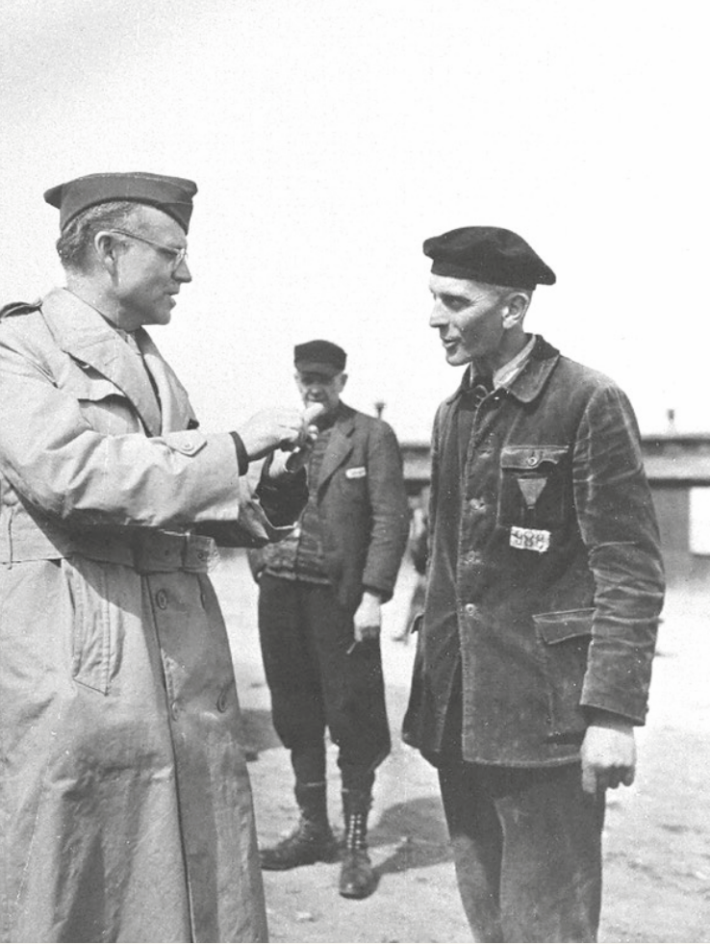
Der Reporter des amerikanischen Radiosenders CBS, Quincy Howe, auf dem Appellplatz im Gespräch mit einem befreiten Häftling (vermutlich der Pole Kazimierz Skupień), nach dem 11. April 1945. Fotograf unbekannt
1/6
Quincy Howe, a reporter for the American radio station CBS, speaking with a liberated prisoner (probably the Pole Kazimierz Skupień) on the roll call square, after 11 April 1945. Unknown photographer ©United States Holocaust Memorial Museum
Die amerikanische Kriegskorrespondentin Margaret Bourke-White bei der Vorbereitung für ein Foto im Hof des Krematoriums, 16. April 1945. Ihre Bilder aus Buchenwald erschienen am 7. Mai 1945 in „Life“, eine der damals auflagenstärksten amerikanischen Wochenzeitungen. Foto: Parke O. Yingst
2/6
American war correspondent Margaret Bourke-White prepares to take a photograph in the crematorium courtyard, 16 April 1945. Bourke-White’s photographs of Buchenwald appeared on 7 May 1945 in Life magazine, one of the most popular American weekly publications at the time. Photo: Parke O. Yingst ©United States Holocaust Memorial Museum
Der österreichische Überlebende Kurt Gatnar führt Chefredakteure und Herausgeber von 18 amerikanischen Zeitungen durch den Keller des Krematoriums, 25. April 1945. Auf Anregung des Oberbefehlshabers der alliierten Streitkräfte, Dwight D. Eisenhower, sollte die Delegation die amerikanische Öffentlichkeit über die Verbrechen informieren. Foto: Louis Nemeth (U.S. Signal Corps)
3/6
Austrian survivor Kurt Gatnar leads chief editors and publishers of 18 American newspapers through the cellar of the crematorium, 25 April 1945. On the suggestion of Dwight D. Eisenhower, Supreme Commander of the Allied Forces, the delegation was tasked with informing the American public about the Nazi crimes. Photo: Louis Nemeth (U.S. Signal Corps) ©National Archives at College Park, Maryland
Schild an der Balustrade des Torgebäudes mit der Bitte an Journalisten, sich im Presseraum zu melden, nach dem 11. April 1945. Neben dem vom Lagerkomitee eingerichteten Pressebüro existierte im April eine vom französischen Überlebenden Maurice Nègre gegründete, konkurrierende „Internationale Pressekommission“, die Journalisten betreute. Foto: John M. Stix
4/6
Sign on the balustrade of the gate building asking journalists to report to the press room, after 11 April 1945. As competition to the camp committee’s press office, in April French survivor Maurice Nègre established the “International Press Commission” to look after visiting journalists. Photo: John M. Stix ©United States Holocaust Memorial Museum
Howard Katzander, Buchenwald, Yank (britische Ausgabe), 11. Mai 1945. Der Artikel war der erste bebilderte und ausführliche Bericht über Buchenwald in einer Soldatenzeitschrift.
5/6
Howard Katzander, Buchenwald, Yank (British edition), 11 May 1945, was the first illustrated and detailed report on Buchenwald published in a soldier’s magazine
Der Buchenwald-Überlebende Paul Heller neben einem US-Soldaten, nach dem 11. April 1945. Der tschechische Arzt jüdischer Herkunft führte unter anderem den amerikanischen Radioreporter Edward R. Murrow durch das Lager, der am 15. April aus Buchenwald berichtete. Fotograf unbekannt
6/6
Buchenwald survivor Paul Heller alongside a US soldier after 11 April 1945. The Czech doctor of Jewish origin guided the American radio reporter Edward R. Murrow and others through the camp. Murrow reported from Buchenwald on 15 April. Unknown photographer ©Courtesy of the Jewish Museum of Maryland, JMM 1990.158.009

In the days and weeks following liberation, scores of representatives from the international press flocked to Buchenwald. Reports, photos and film footage were sent around the world. For a time, the camp was the focal point of American and Western European reporting on the concentration camps. On 15 April 1945, millions of people listened to the report “What I saw at Buchenwald” by the American reporter Edward R. Murrow. Survivors accompanied reporters around the grounds and described the conditions in the concentration camp.

var _paq = window._paq = window._paq || []; /* tracker methods like "setCustomDimension" should be called before "trackPageView" */ _paq.push(['trackPageView']); _paq.push(['enableLinkTracking']); (function() { var u="https://matomo.buchenwald.de/"; _paq.push(['setTrackerUrl', u+'matomo.php']); _paq.push(['setSiteId', '1']); var d=document, g=d.createElement('script'), s=d.getElementsByTagName('script')[0]; g.async=true; g.src=u+'matomo.js'; s.parentNode.insertBefore(g,s); })();