Opening Hours Practical Info What is where? Apps Public Tours further language offers Accessibility FAQ

DYING

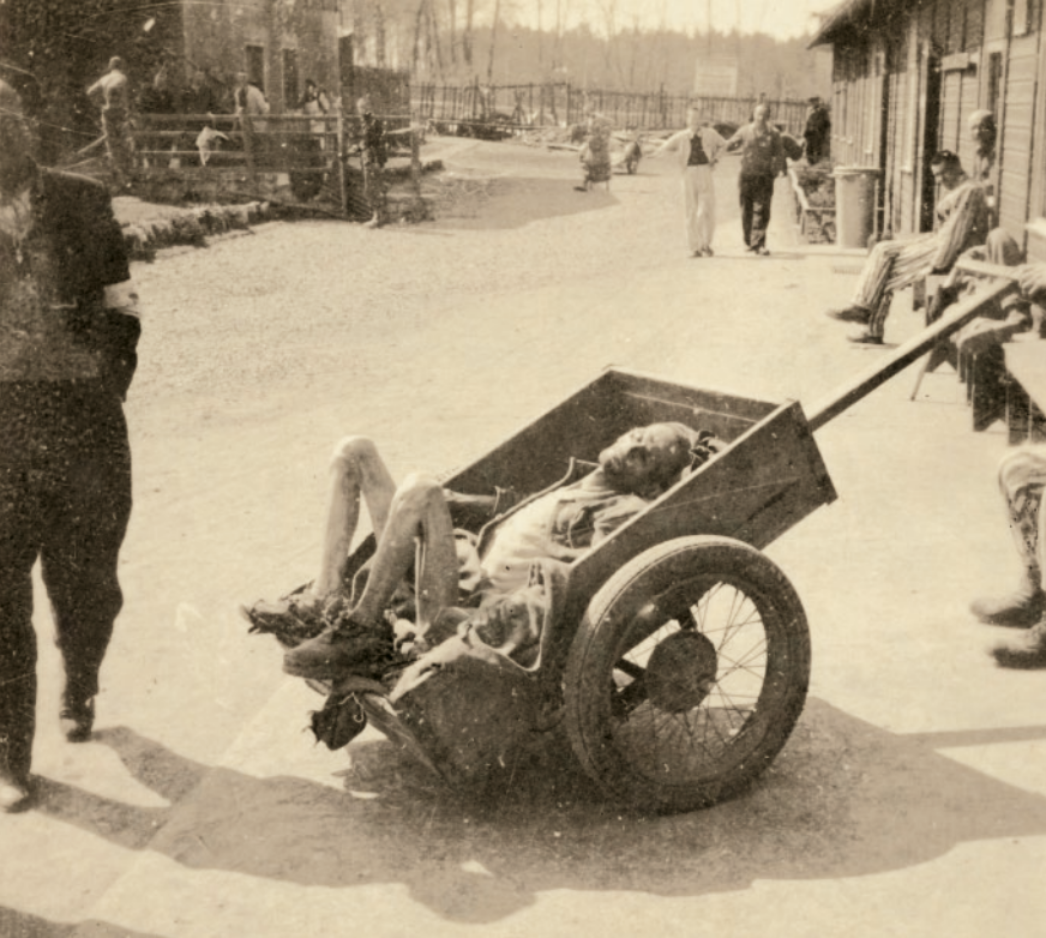
Verstorbener Häftling in einem Handkarren vor der Baracke 1 des Häftlingskrankenbaus, 16. April 1945. Der Leichnam wurde wahrscheinlich in den Hof des Krematoriums gebracht, wo die Toten vor der Beerdigung gesammelt wurden. Fotograf unbekannt
A dead prisoner in a handcart in front of Barrack 1 of the prisoner infirmary, 16 April 1945. The body was probably taken to the crematorium courtyard, where the dead were collected before burial. Unknown photographer ©Privatbesitz

Rolf Weinstock, a Jewish survivor from Emmendingen near Freiburg, describes the people dying in the liberated camp:


“All the necessary medicine and urgently needed bandages were brought in right away to reduce the death rate as quickly as possible. Yet, despite all the aid measures, this could not be achieved as quickly as desired. There were far too many prisoners in a desperate state. There were prisoners in our district between the ages of 30 and 50 who only weighed around 25 kilograms. There was simply no hope of saving their lives. It was only a small consolation that these poor people had the joy of experiencing the day of liberation.”

Rolf Weinstock, Das wahre Gesicht Hitler-Deutschlands, Singen 1948.

Ein Anhänger mit zugedeckten Leichnamen im Hof des Krematoriums, um den 24. April 1945. Foto: Thérèse Bonney
1/6
A cart with covered corpses in the crematorium yard, around 24 April 1945. Photo: Thérèse Bonney ©The Regents of the University of California, The Bancroft Library, University of California, Berkeley. This work is made available under a Creative Commons Attribution 4.0 license.
Der 46-jährige Belgier Alfred Delire in einem der Nothospitäler in Buchenwald, 24. April 1945. Der Familienvater aus Ciney starb zwei Tage nach der Aufnahme und wurde auf dem Friedhof am Bismarckturm beigesetzt. Foto: François-Louis Ganshof
2/6
Alfred Delire, a 46-year-old Belgian, in an emergency hospital in Buchenwald, 24 April 1945. The husband and father from Ciney died two days after the photo was taken. He was buried in the cemetery at the Bismarck Tower. Photo: François-Louis Ganshof. ©CegeSoma, Brüssel
Ein Beerdigungszug Überlebender vor dem Lagertor auf dem Weg zum Friedhof am Bismarckturm, zwischen dem 28. April 1945 und dem 12. Mai 1945. Foto: William Garrison Birch
3/6
A funeral procession of survivors in front of the camp gate on their way to the cemetery at the Bismarck Tower, between 28 April 1945 and 12 May 1945. Photo: William Garrison Birch ©United States Holocaust Memorial Museum
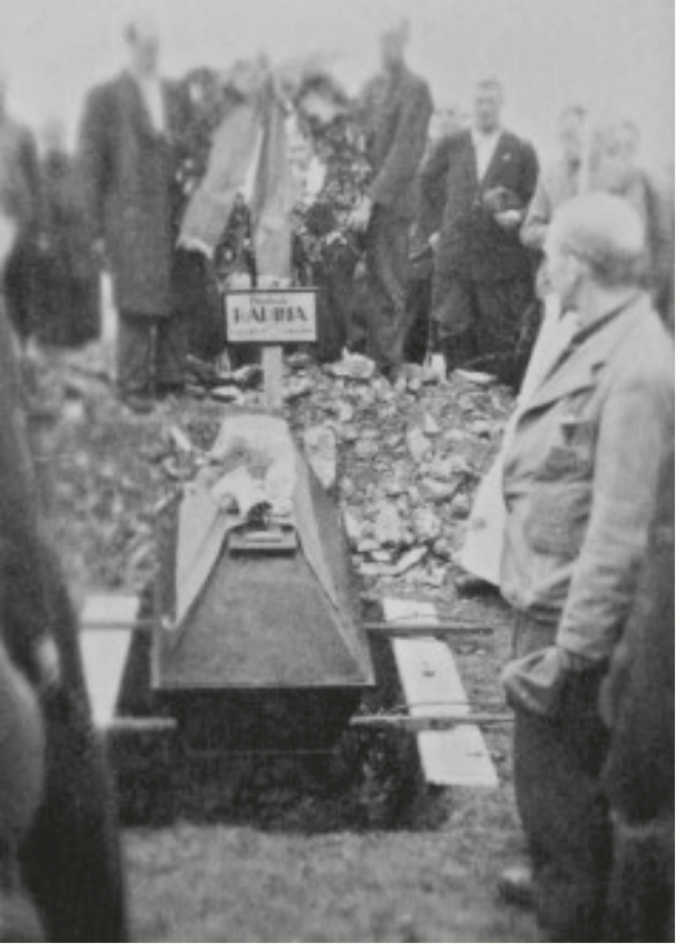
Beerdigung des am 26. April 1945 an einer Blutvergiftung verstorbenen Tschechen František Radina auf dem Friedhof am Bismarckturm, um den 27. April 1945. Die Gräber wurden mit Schildern, Kreuzen und Davidsternen gekennzeichnet. Foto: Alfred Stüber
4/6
František Radina, from Czechoslovakia, who died of blood poisoning on 26 April 1945, being buried in
the cemetery at the Bismarck Tower, around 27 April 1945. The graves were marked with signs, crosses and Stars of David. Photo: Alfred Stüber ©Jehovas Zeugen, Archiv Zentraleuropa
Burial of 1286 urns of deceased prisoners of Buchenwald concentration camp. The Bismarck Tower can be seen in the background. In the foreground, three men stand around a freshly dug grave. Further back at the Bismarkturm a crowd of people.
5/6
Graves at the foot of the Bismarck Tower, 20 June 1945. The last burials in the cemetery at the Bismarck Tower took place in July 1945. The grave markers disappeared over the following years. The cemetery was redesigned in 1996. Photo: George A. Haynia (U.S. Signal Corps) ©National Archives at College Park, Maryland
Beisetzung von Leo Peeraer auf dem Weimarer Hauptfriedhof, 28. oder 29. April 1945. Der Belgier starb nach seiner Abreise aus Buchenwald in einem Hilfslazarett in der Pestalozzischule in Weimar. Später wurden seine sterblichen Überreste in seine Heimat überführt. Fotograf unbekannt
6/6
Burial of Leo Peeraer in Weimar’s main cemetery, 28 or 29 April 1945. After leaving Buchenwald, the Belgian man died in an auxiliary hospital in the Pestalozzi school in Weimar. His remains were later returned to his home country. Unknown photographer. ©Buchenwald Memorial

Despite the emergency medical measures being taken, help came too late for many of the weak and ill. The number of deaths declined slowly. By early July 1945, several hundred liberated prisoners had died in the liberated camp and nearby hospitals of exhaustion, lung disease, typhus and other illnesses. The dead were buried in mass graves shortly after the camp was liberated. In late April, a cemetery was created at the nearby Bismarck Tower. The dead were buried there with dignity and respect for their religion. The cemetery is now part of the memorial complex.


var _paq = window._paq = window._paq || []; /* tracker methods like "setCustomDimension" should be called before "trackPageView" */ _paq.push(['trackPageView']); _paq.push(['enableLinkTracking']); (function() { var u="https://matomo.buchenwald.de/"; _paq.push(['setTrackerUrl', u+'matomo.php']); _paq.push(['setSiteId', '1']); var d=document, g=d.createElement('script'), s=d.getElementsByTagName('script')[0]; g.async=true; g.src=u+'matomo.js'; s.parentNode.insertBefore(g,s); })();