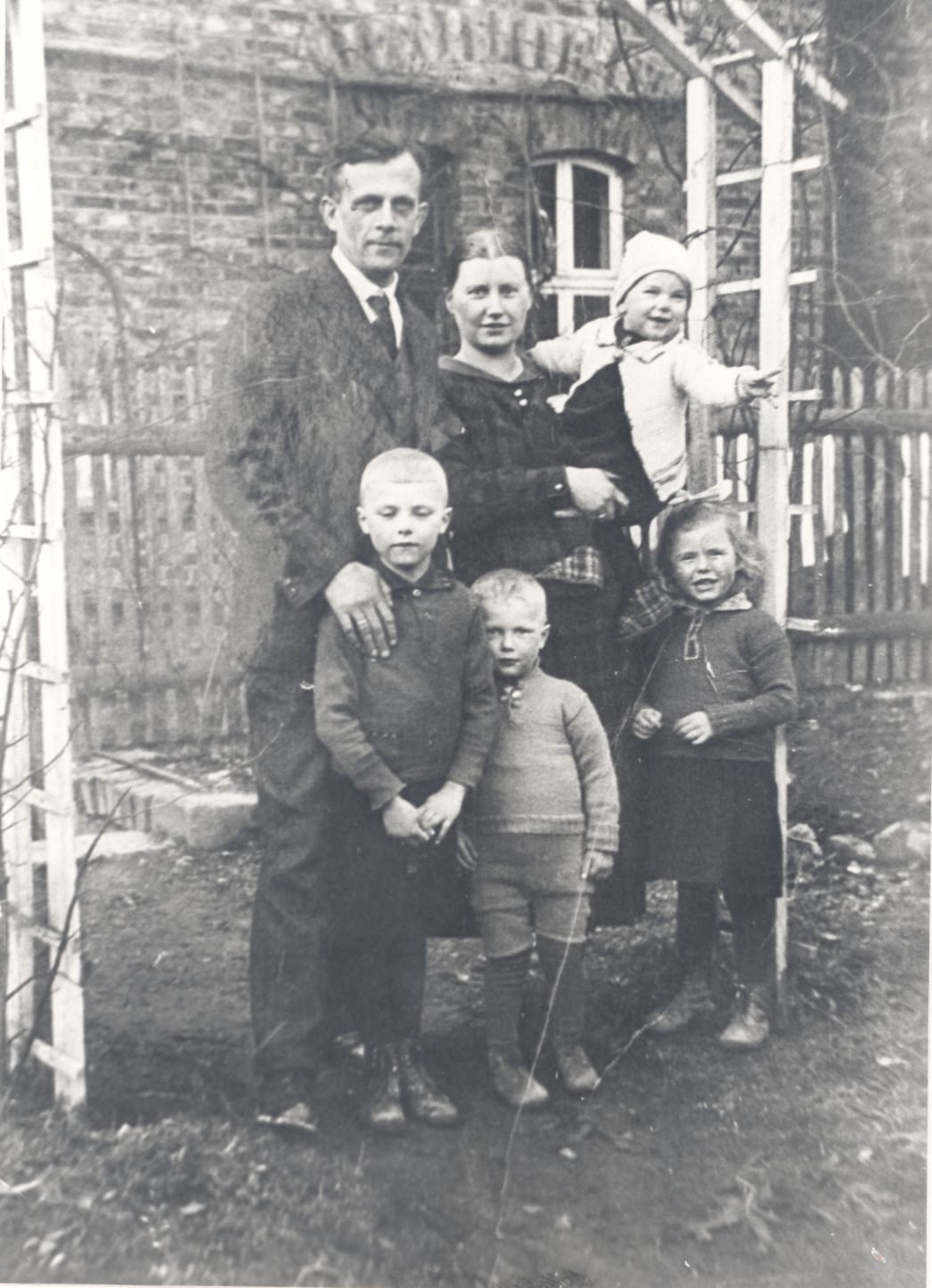
Paul Schneider was born on August 29, 1897, in Pferdsfeld in the Hunsrück region and grew up in a Protestant parsonage. After passing his high school equivalency exam in 1915, he served in the military until the end of World War I, ultimately as a second lieutenant. From 1919 to 1922, he studied Protestant theology; this was followed by a pastoral training program in Soest and then a position with the Berlin City Mission. In 1926, he took over his late father’s parish in Hochelheim and Dornholzhausen. That same year, he married Margarete Dieterich; the couple had six children.
Schneider, who held national-conservative views, did not initially oppose National Socialism on principle and briefly joined the National Socialist-oriented “German Christians” in July 1933. Soon, however, he turned against their ethno-nationalist doctrine and the Nazi state’s political encroachment on the church. Because of his public criticism, the church authorities transferred him in 1934 to Dickenschied and Womrath in the Hunsrück region. There, he joined the Confessing Church and once again came into conflict with Nazi officials and state authorities. He was arrested on several occasions. In July 1937, the Gestapo expelled him from the Rhine Province.
Schneider refused to accept his expulsion because he continued to see himself as committed to serving his congregations as a pastor. On October 3, 1937, he returned to Dickenschied and conducted the harvest festival service there. He was arrested again that very same day. In late November 1937, the Gestapo transferred him from the prison in Koblenz to the Buchenwald concentration camp.
In the camp, Schneider was forced to perform hard labor. During the flag ceremony on Hitler’s birthday on April 20, 1938, he refused to salute the swastika flag by removing his cap. The SS mistreated him and locked him in the detention block. He remained there in solitary confinement until his death.
From the barred window of his cell, Schneider calls out Bible verses and messages to the prisoners standing on the roll call ground. He denounces the abuse and murders committed by the SS and encourages his fellow prisoners. Among the prisoners, he therefore becomes known as the “Preacher of Buchenwald.”

During his 14 months in the detention cell block, Schneider was repeatedly severely mistreated. On July 18, 1939, the camp doctor Erwin Ding-Schuler murdered him with an overdose of strophanthin. His funeral a few days later in Dickenschied took place amid great public sympathy.