
Transcript
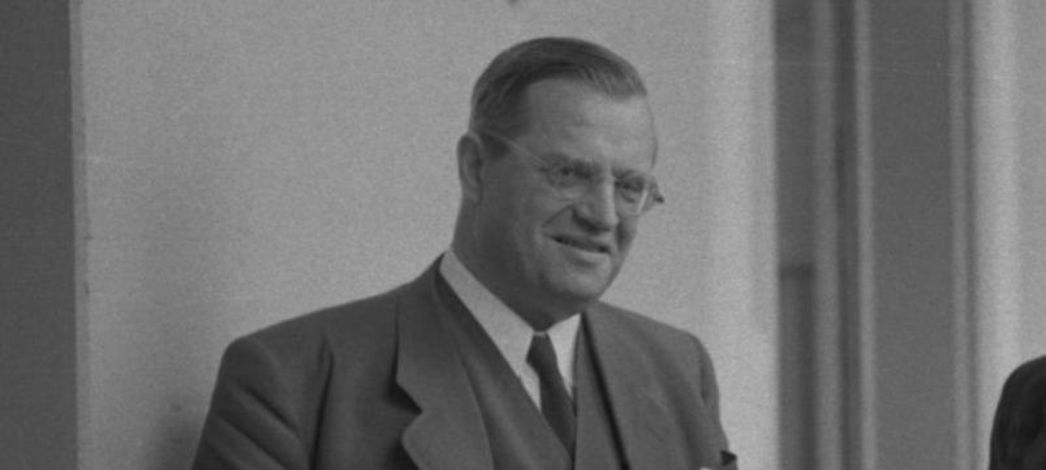
Narrator There is a fire in Leipzig. On the morning of November 10, 1938, a Jewish commercial building on the central Augustusplatz is ablaze, and with it, the office of a tax and business consultant. It is one of more than 200 “properties” destroyed during the “Night of the Pogroms” in Leipzig. The office belongs to Werner Hilpert. He sees the fire and stands in front of the building with the owner, Bamberger, his friend. Years later, he will briefly say of this:
Werner Hilpert “My life’s work was gone.”
Narrator For years, Hilpert has also been active as a lawyer for Jewish citizens. On several occasions, he succeeds in securing the release of clients from the Buchenwald concentration camp. He is well-respected in the city. Leipzig’s mayor, Carl Goerdeler, supports his work; in late 1936, he also backs Hilpert’s fight to preserve Catholic schools in Saxony. Afterward, Hilpert is barred from practicing law. He is able to continue working only because the court proceedings on the appeal drag on for a long time.
Werner Hilpert comes from a Catholic family and openly practices his religious beliefs. In the summer of 1933, at the instigation of the NSDAP, he loses his livelihood—as well as his position as state chairman of the Center Party. In that role, he had warned against the NSDAP. He goes into private practice and, at the end of August 1939, following the fire, draws up his will.
As early as the beginning of September, he was arrested in his apartment and, a week later, deported to Buchenwald without trial. He was imprisoned there for six years.
On his first Christmas in the concentration camp, he runs into a boy from his neighborhood in Leipzig. It is not a joyful reunion. As an SS officer, the boy knocks out Hilpert’s teeth. By this time, Hilpert is already working under the harshest conditions in the nursery. He is exposed to the elements and the constant hazing by the SS. Later, he manages to get transferred to an easier work detail, the tailor shop. There he meets Eugen Kogon, with whom he becomes friends. Kogon recalls that Hilpert:
Eugen Kogon “He did everything tirelessly [...] to save us from destruction. [...] In 1941–42, a particularly large number of French prisoners were admitted. They were in truly miserable condition; they were dying by the dozen every day. Hilpert began to [...] systematically provide them with clothing from the tailor’s shop, even if it was just a piece of woolen blanket to sew into the back of their jackets. It was often these ‘small acts of kindness’ that could save one’s life under the prevailing circumstances.”
Narrator Starting in February 1944, Hilpert, under the chairmanship of the Social Democrat Hermann Brill, became a member of the illegal People’s Front Committee formed by prisoners in the camp. They discussed the democratic restructuring of Germany. After liberation, Hilpert was one of five Germans on the International Camp Committee, which, among other things, worked to secure the food supply.
After briefly serving as the trustee of Nazi assets for Weimar, he held several professional positions before ultimately becoming director of the Deutsche Bundesbahn: He served as managing director of the Chamber of Industry and Commerce in Frankfurt, deputy prime minister of Hesse, the state’s minister of economy and finance, and co-founder and state chairman of the Hesse CDU.