
Transcript
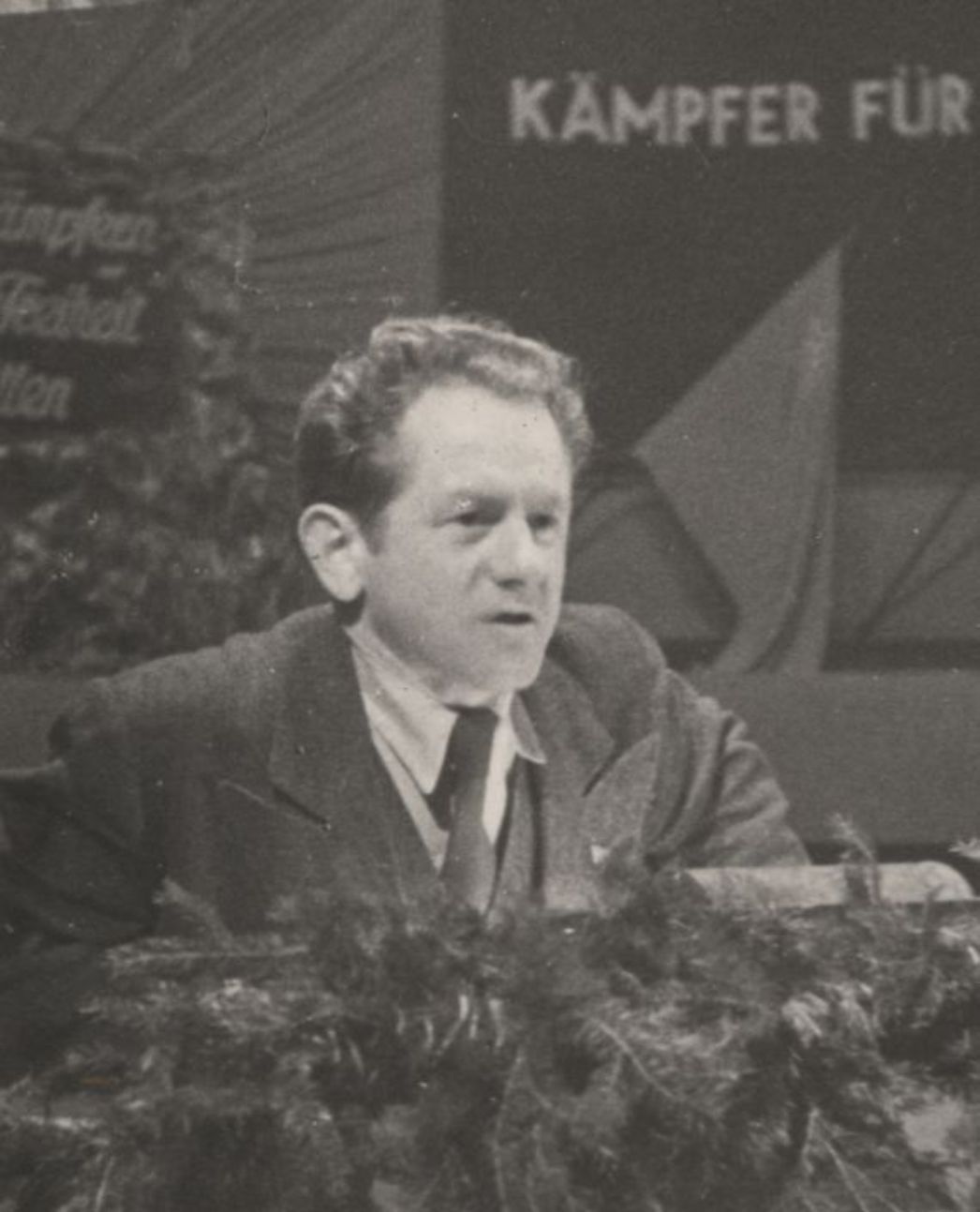
Narrator 1 In September 1940, he is summoned to the Gestapo barracks, where he puts on a suit jacket and a shirt, ties on a tie, and takes his place in front of the identification service’s camera. A photo for his military exemption certificate—then he slips back into his prison clothes, disappears into the carpentry shop, where he works as a clerk—and once again goes unnoticed.
Narrator 2 The office clerk Walter Bartel is a quiet but persistent character. This trait is instilled in him early on. The socialist working-class family into which he grows up often struggles. He and his five siblings start working at an early age. He delivers newspapers in Berlin, yet still graduates at the top of his class and becomes an apprentice at the Berlin pharmaceutical factory Noffke & Co. His parents and siblings introduce him to the left-wing youth movement. There he meets the children of KPD functionary Wilhelm Pieck, who takes him under his wing. At age 18, he began his career as an official in the Communist Youth League; by 24, he was an employee of the Communist Party. In 1929, the party sent him to the International Lenin School in Moscow, where he studied for three years. This marked the potential start of a career in the party loyal to Stalin. Upon his return, he worked as an agitator; after the Nazis seized power, he served as a courier using forged papers. He rarely saw his wife and two sons. In June 1933, the Gestapo arrested him with courier materials.
He is convicted and serves time in the notorious Brandenburg prison until the fall of 1935. During this time, his younger son dies in exile in Moscow, and his older son later dies in a tragic accident in London.
Narrator 1 The Party is his family. After his release, it sends him into exile in Czechoslovakia—and then expels him. Everyone distrusts everyone else. He is accused of having signed a Gestapo statement upon his release; an accusation without evidence. They withdraw their support. He is on his own. And when the Wehrmacht marches into Prague, he is arrested again. Months with the Gestapo, then, in the fall of 1939, Buchenwald concentration camp.
Narrator 2 Buchenwald is a turning point for him; it will shape the rest of his life. The communists in the camp trust him. He knows some of them from before; he was in Moscow with the head of the underground leadership, Albert Kuntz. He can speak with Czech and Russian communists in their own languages and gains their trust. That is the beginning. Persistently, he expands his network of contacts to include communists from other nations as well. Always the unassuming clerk in the carpentry shop. Regular secret meetings follow. He would later describe these as the founding of the illegal International Camp Committee. And he remains its networker until the camp’s liberation. When the committee emerges, he is the only one everyone knows—the chairman, the author of the Buchenwald Oath.
Narrator 1 His third life begins after his return. He becomes a co-founder of the Association of Victims of Nazi Persecution, personal secretary to Wilhelm Pieck, and a professor of contemporary history. Like other Buchenwald communists, Walter Bartel comes under pressure within the SED in the postwar years. Yet he remains a propagandist for his party, bringing the history of Buchenwald in line with its agenda. And he is one of the leaders of the International Buchenwald Committee.