Transcript
Narrator A summer day in 1933. Rudolf is strolling through the small Thuringian town of Meuselwitz with the love of his life. Hand in hand, they walk along the streets, wandering through the park and the orangery: Rudolf and Werner.
They have recently moved in together and kiss in full view of everyone. A summer later, they get married—in an impromptu and exuberant ceremony. Through this first love, Rudolf experiences his coming out as gay. But the happy years come to an abrupt end when he is arrested in the spring of 1937. Although this danger looms, he does not consider fleeing:
Rudolf Brazda “No, no, I didn’t know where to go; I took everything personally, and since they locked up my friends, I’ll be locked up too. [...] I never thought that the [Nazis] had any intention of exterminating us [homosexuals] in concentration camps.”
Narrator In fact, the open atmosphere in the small town is a remarkable exception. Since the Nazis came to power, the situation for homosexuals has been dire.
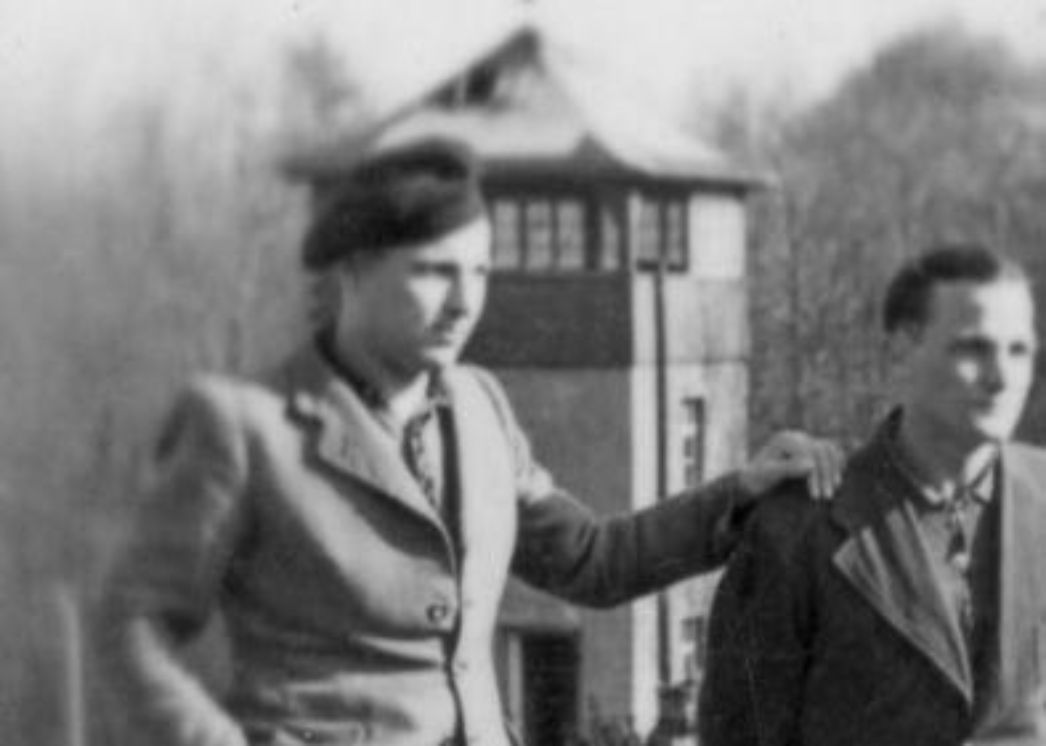
After his first imprisonment, Rudolf is forced to leave the country. He is 24 years old when he arrives in Karlovy Vary, Czechoslovakia. There, he is arrested for the second time in 1941. He serves his entire sentence, but is not released; instead, he is placed in so-called “protective custody” and deported to Buchenwald in August 1942. Marked with the pink triangle, he belongs to one of the prisoner groups at the very bottom of the hierarchy. Like other homosexuals, he is sent to the penal company. There, Rudolf must work every day in the quarry under the harshest conditions, with less food and reduced breaks. A total of around 650 homosexuals are imprisoned in Buchenwald.
What follows is an exception: a Kapo, who supervises the prisoners’ work on behalf of the SS, helps Rudolf get transferred from the quarry to a less deadly work detail—as a trained roofer, to the construction detail. This saves his life for the first time. He meets Fernand, who becomes his lover.
Rudolf Brazda “In the roofing work detail, I had a coworker with whom I formed a close friendship. He was about my age, this Fernand. I called him Nandi. [...] [It wasn’t] exactly love, not really at all—just sex. He was decent, and I was glad I’d found someone.”
Narrator Rudolf is forced to remain in Buchenwald for three years; his life is saved there three times, by three Kapos. He is also protected by a powerful group of prisoners: the German communists, because he had been a member of a communist gymnastics club as a teenager.
In late April 1945, just under two weeks after their liberation, Rudolf and Fernand travel to France. They do not stay together. Rudolf finds his lifelong love in Edi.
Paragraph 175 outlasts the Third Reich. In the Federal Republic, it is not repealed until 1994 after three rounds of reform. In the GDR, the Nazi version does not apply; homosexuality is not decriminalized there until 1988. In both German states, those persecuted for homosexuality continue to be considered criminally convicted. They are rehabilitated in 2002.
Sixty-five years earlier, during his 1937 interrogation, Rudolf Brazda could describe the “crime” he was charged with as nothing other than—love:
Rudolf Brazda “I was very fond of [Werner] Bilz, and I felt drawn to him out of love.”