
Transcript
Narrator A lifelong journalist and dog lover. Martin Hamburger led a long life that can be broken down into decades:
At 20, he began his career as a journalist,
at 30 he got married,
at 40 he joined the SPD,
at 50 he became editor-in-chief of the Berliner Illustrierte Nachrichten,
at 60 he was arrested by the Gestapo, deported to Buchenwald, and forced into exile,
at 70, widowed, he returned from exile to Berlin and remarried.
Martin Hamburger died at the age of 86.
Martin Hamburger is particularly attached to his dog “Lottchen.” She is born in 1936. It is the time when he tries in vain to emigrate from Germany. Ever since the Nazis came to power in 1933, the Jewish journalist and Social Democrat has been barred from practicing his profession. He scrapes by as a sales representative. When he is arrested on June 14, 1938, he is 62 years old. His loyal dog tries to protect him:
Martin Hamburger “When the Gestapo arrested me and took me to the concentration camp, she barked furiously at the officers.”
Narrator In Buchenwald, Martin Hamburger is registered as a Jewish ASR prisoner. ASR stands for Arbeitsscheu Reich (Work-Shy Reich). This is what the Gestapo called the largest wave of arrests in 1938. It targeted people who had always been marginalized: the homeless, beggars, and those who refused to comply with the labor regime. None of them belonged to the new community.
But it is also pointedly directed against the Germans whom the Nazis had intended to expel from the country from the very beginning: Jews, Sinti, and Roma. From April to June 1938, more than 10,000 people were deported to concentration camps, 4,000 to Buchenwald alone.
The SS no longer had barracks for the Berlin Jews. They are housed in an old sheep pen—500 men in a cramped space—with pine branches on the bare floor instead of beds—five men sharing one loaf of bread and each receiving half a liter of watery soup per day—woken up at 3 a.m. every day and forced to work on building the camp until nightfall. It is not until the end of August that they are at least moved into barracks.
At this point, the Gestapo releases Martin Hamburger from Buchenwald. He has a chance of obtaining a visa to go abroad, which is likely the deciding factor. His new passport, marked with a large “J,” is valid for only one year. But most countries do not want Jewish refugees. Shortly before this deadline expires, he seizes the only remaining chance to emigrate: Shanghai. The city, occupied by the Japanese, does not require an entry visa.
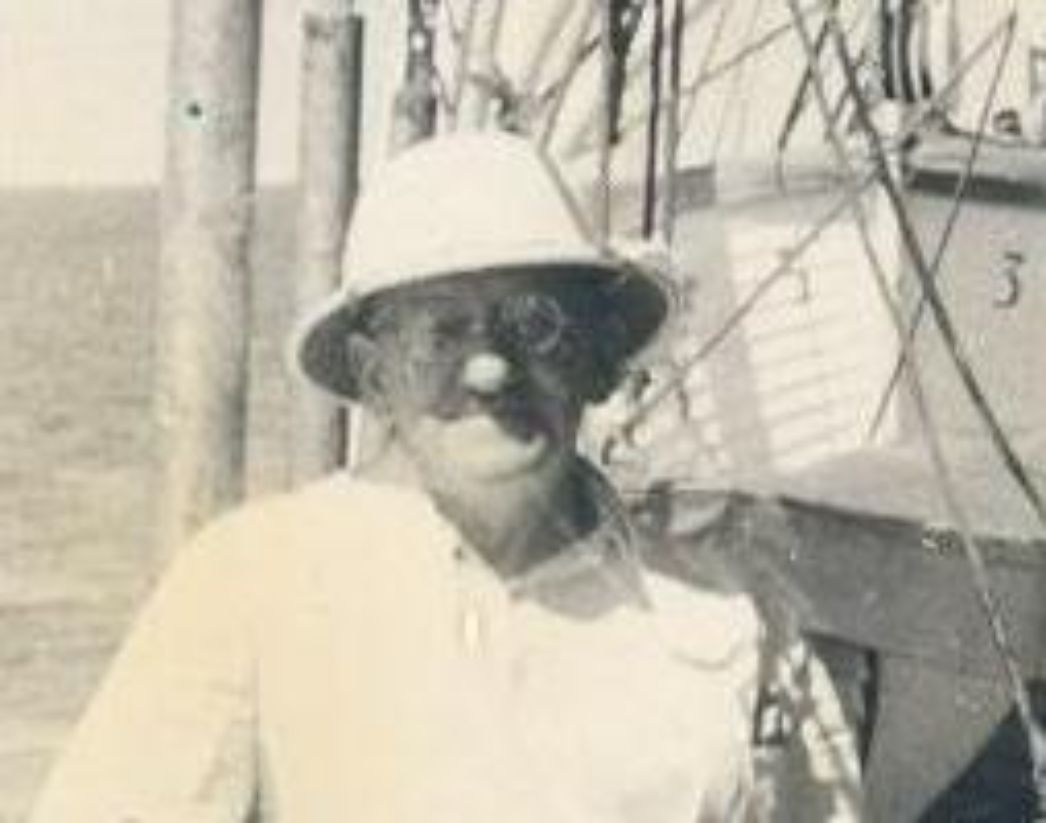
In May 1939, Martin Hamburger, his wife, and their dog “Lottchen” boarded a ship in Hamburg. It took them into exile. In Shanghai, he occasionally wrote for English-language foreign press publications and for a Jewish newspaper. Life for the refugees was hard, and it grew worse as the war progressed. The Japanese established a ghetto in the city where all Jews were now forced to live. They survived this period, but months after the war ended, Martin Hamburger’s wife Elsa died. In the summer of 1947, he returns to Berlin alone—but still with “Lottchen” by his side. He is now 71 years old, marries again, continues to work as a journalist, struggles with financial difficulties, and waits years for his application for compensation to be approved. When his faithful dog dies in 1951, he writes an obituary for her.