Transcript
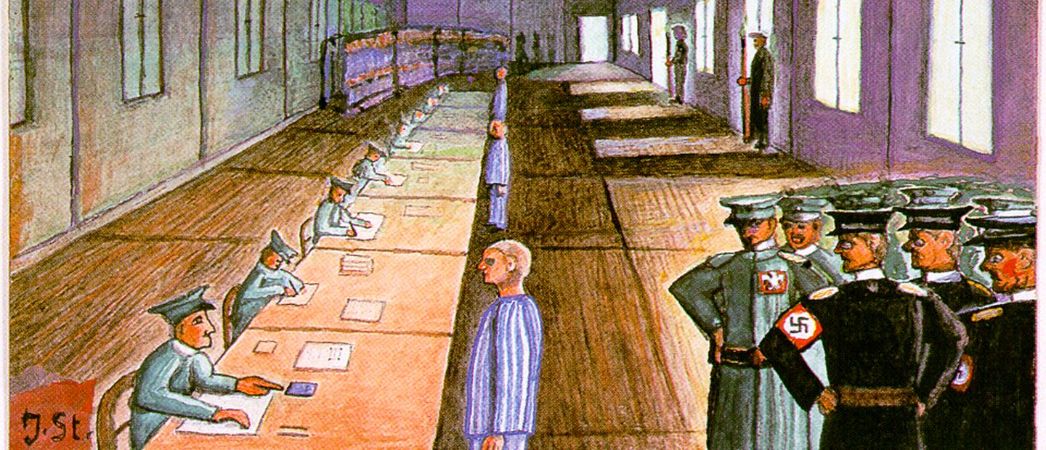
Narrator A glimmer of hope, a ray of sunshine, moonlight: Johannes Steyer’s paintings always feature a radiant symbol of hope—no matter how hopeless the situation may seem. For 10 years, Steyer was detained in concentration camps as a so-called “Bible Student.” In the 1970s, Steyer painted 27 watercolors in which he captured his memories of this time in captivity.
Johannes Steyer was born in 1908. He came from a poor background and worked as a needle setter for knitting machines. In 1931, he came into contact with the Jehovah’s Witnesses and joined them. Shortly after the Nazis “seized power,” they banned this community. Nevertheless, Steyer continued to try to proselytize people for the Jehovah’s Witnesses.
His watercolors depict the period beginning in 1935: because of his missionary activities, Steyer was reported, arrested, and interrogated. He was first sent to the Sachsenburg concentration camp. From there, he was transferred in the summer of 1937 to Buchenwald, which was then under construction. In his paintings, he depicts the grueling labor:
Johannes Steyer “The painting shows the construction of the Buchenwald concentration camp. We had to perform all the associated tasks: from clearing the forest and laying the foundations to building the barracks. Everything had to be done by laborious manual labor.”
Narrator The SS was usually unable to break the faith of the Jehovah’s Witnesses. As a result, they were forced to work in hard-labor units and were punished and isolated with particular frequency:
Johannes Steyer “Even on Sundays, the Jehovah’s Witnesses had to work as a group until noon—without lunch. The rations were distributed among the (other) prisoners.”
Narrator In several watercolors, Johannes Steyer captures the brutal daily life of the camp: abuse by SS men and Kapos, grueling labor in the quarry, hours-long roll calls. One painting depicts the punishment of a prisoner with 25 lashes—yet even here the sun shines: hope, however, still seems far away beyond the camp gate.
Johannes Steyer has a clear enemy: Hitler, whom he paints in two pictures. Steyer is convinced that the Catholic Church is behind the Nazis’ persecution policies. Like many Jehovah’s Witnesses, he refuses to give the “Hitler salute” and to perform military service. Enlisting in the military would have allowed him to end his concentration camp imprisonment. Since Johannes Steyer continued to refuse even after the war began, he was sentenced to death. He escaped execution, however, because he was sent—likely by mistake—to perform labor duties.
In 1940, Johannes Steyer was sent to the Sachsenhausen concentration camp; later, as a member of an “SS construction brigade,” he was forced to carry out cleanup work following bombing raids. He was repeatedly transferred to other camps. His final paintings depict scenes from the period following liberation: Steyer gives thanks to God and feels redeemed; the liberated prisoners run toward the radiant light.
Johannes Steyer “It seemed as though nature, now awakening, shared our joy. Flowers bloomed; everything came to life anew.”
Narrator Sixty years after the start of his imprisonment at Buchenwald, his watercolors are exhibited for the first time at the Buchenwald Memorial. At the exhibition opening, he presents his paintings to the public. A year later, on March 1, 1998, Johannes Steyer dies.