
Transcript
Speaker 1 “Have you ever been in court before?
Did you beat other prisoners?
What color was the patch on your prison uniform?”
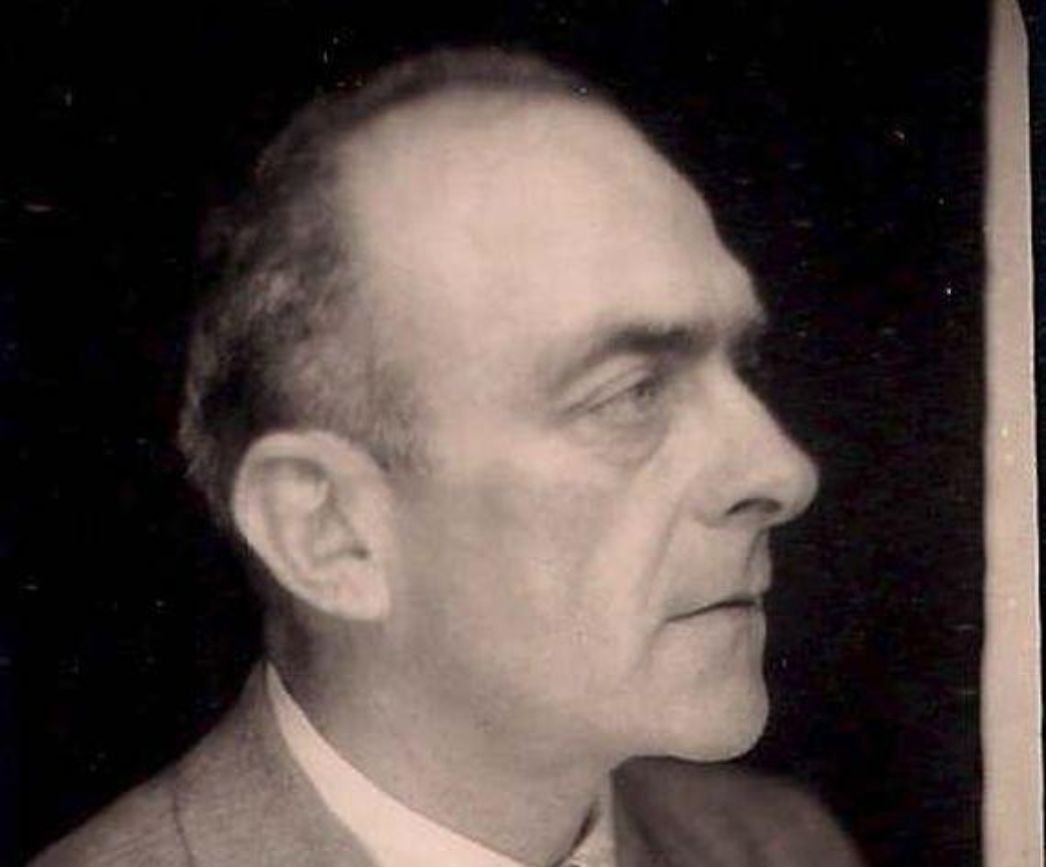
Speaker 2 Carl Schrade has actually been summoned as a witness at the Flossenbürg trial in Dachau to testify against SS men and so-called “functionary prisoners.” But on this day in June 1946, he must defend himself. The defense attorneys are trying to discredit him in court. However, they do not succeed. Former fellow prisoners recall Schrade’s helpfulness and dedication as a functionary prisoner in an extremely positive light.
So why the questions?
Carl Schrade is a so-called BV prisoner—a “preventive prisoner,” usually referred to simply as a “professional criminal.” Within the police force, this term was already commonly used in the 1920s to describe people who had committed multiple crimes. After the National Socialists seized power, it became a category in the concentration camps. The SS and police spoke of a “healthy national body,” viewing people like Carl Schrade as diseased parts to be cut out and discarded. The SS also planned new camps like Buchenwald for this racist concept.
Carl Schrade is a threat to no one. It is rather the circumstances that bring him into conflict with the law. Born in Zurich to German parents, he grows up in Switzerland, yet is drafted into military service at age 19 and survives several years in the trenches of World War I.
As a 23-year-old war veteran back in Berlin, he tries his hand at various things: he works as a middleman, makes shady acquaintances, and eventually ends up in court several times. In 1934, after serving his last sentence, the Nazis are in power. The criminal police pick him up at the prison gate. Eleven years in concentration camps lay ahead of him: Lichtenburg, Esterwegen, Sachsenhausen, Buchenwald, Flossenbürg. On July 15, 1937, he was transported from Sachsenhausen to Ettersberg near Weimar on the first convoy. The workday lasted 14 hours as they built the camp. But Carl Schrade is lucky; he is put to work in the canteen and is even able to pass food on to fellow prisoners. The experiences of Buchenwald haunt him for the rest of his life:
Carl Schrade “I can still see the columns of my weakened, completely exhausted comrades,” he recalls, “as they passed beneath the window of the office where I sat, all those men who are dead today, having died of exhaustion, thirst, and despair, only to be replaced by others who would soon collapse as well and be replaced by thousands more like them: ceaseless movement, a hellish cycle of slavery that no one can stop...” ”
Narrator 2 To leave Buchenwald, he volunteered in 1939 for a transport to the Flossenbürg concentration camp. Once there, he was initially forced to work in the granite quarries. His organizational skills saved him: he was transferred to the administration, worked in the construction office, and became block elder and kapo of the infirmary block. Within the limits of his ability, he protects the sick prisoners there, ensuring the fair distribution of food and medications behind the SS doctor’s back. In this way, he tries to spare at least some of the sick from the camp doctor’s often life-threatening procedures and experiments.
After the liberation, Carl Schrade helped U.S. Army medics care for the camp’s sick, then spent a year in Paris before finally returning to his hometown of Zurich. There, he worked as a clerk and later obtained Swiss citizenship. Before that, however, he had to endure the fact that his category of imprisonment in the concentration camp continued to be viewed with prejudice even in the postwar period. Former prisoners who wore the green triangle had no chance of receiving compensation payments and were not recognized as victims in the public eye. Carl Schrade therefore initially claimed that he had also been arrested for his political beliefs. But it is to no avail. In 1958, Carl Schrade’s application for compensation is definitively rejected. He writes a lengthy account of his experiences, which is published forty years after his death.