
Transcript
Speaker 1 “Those who take up the sword will perish by the sword.” Whenever Alois Kasperkowitz meets people, he quotes the Bible. For he is a Jehovah’s Witness and has dedicated his life to spreading their teachings. Closely bound to their community, they refuse to participate in war or perform military service. As a result, they become victims of persecution.
Alois Kasperkowitz works as a newspaper delivery boy and a day laborer. He knows the mailboxes in Vienna’s 12th district, where he lives with his partner and his five-year-old daughter. He is constantly on the move for the Jehovah’s Witnesses, distributing their literature and printing leaflets himself. In mid-July 1941, he even slips a brochure into the private mailbox of the head of the Vienna Gestapo. This lands him in the clutches of persecution. In the fall of 1941, he is arrested.
In court, he is accused of spreading anti-war propaganda. In the third year of the war, this is a particularly serious charge, one that the Nazis typically punish with death. Everyone knows this. There have been similar cases. And yet Alois Kasperkowitz continues to proclaim his beliefs with fervor, even in the courtroom. This surprises even the judges of the Special Court: his zeal is so exuberant that hardly anyone would have believed his words. This saves him from the executioner. In the spring of 1942, the Special Court in Vienna sentences him to 10 years in prison. The court’s reasoning states:
Speaker 2 “The defendant also firmly stands by his convictions and states that he is not permitted to […] perform military service, because he has made a covenant with God. […] He would have liked to place a pamphlet in every home, if that had been possible. […] Furthermore, the defendant also expressly stated that he would have to continue working for the truth if he were released.”
Speaker 1 Kasperkowitz is sent to prisons notorious for their harsh conditions. Most recently, to the Waldheim Penitentiary in Saxony. At the end of 1942, the judiciary began deporting prisoners serving long prison sentences to concentration camps. Their murder was the declared goal. In the fall of 1943, the Leipzig Criminal Police picked up Alois Kasperkowitz at the Waldheim Penitentiary and took him to Buchenwald Concentration Camp. They wanted to ensure that he died there. For this reason, he is placed in the prisoner category “preventive detainee/habitual criminal” and not in the barracks for Jehovah’s Witnesses.
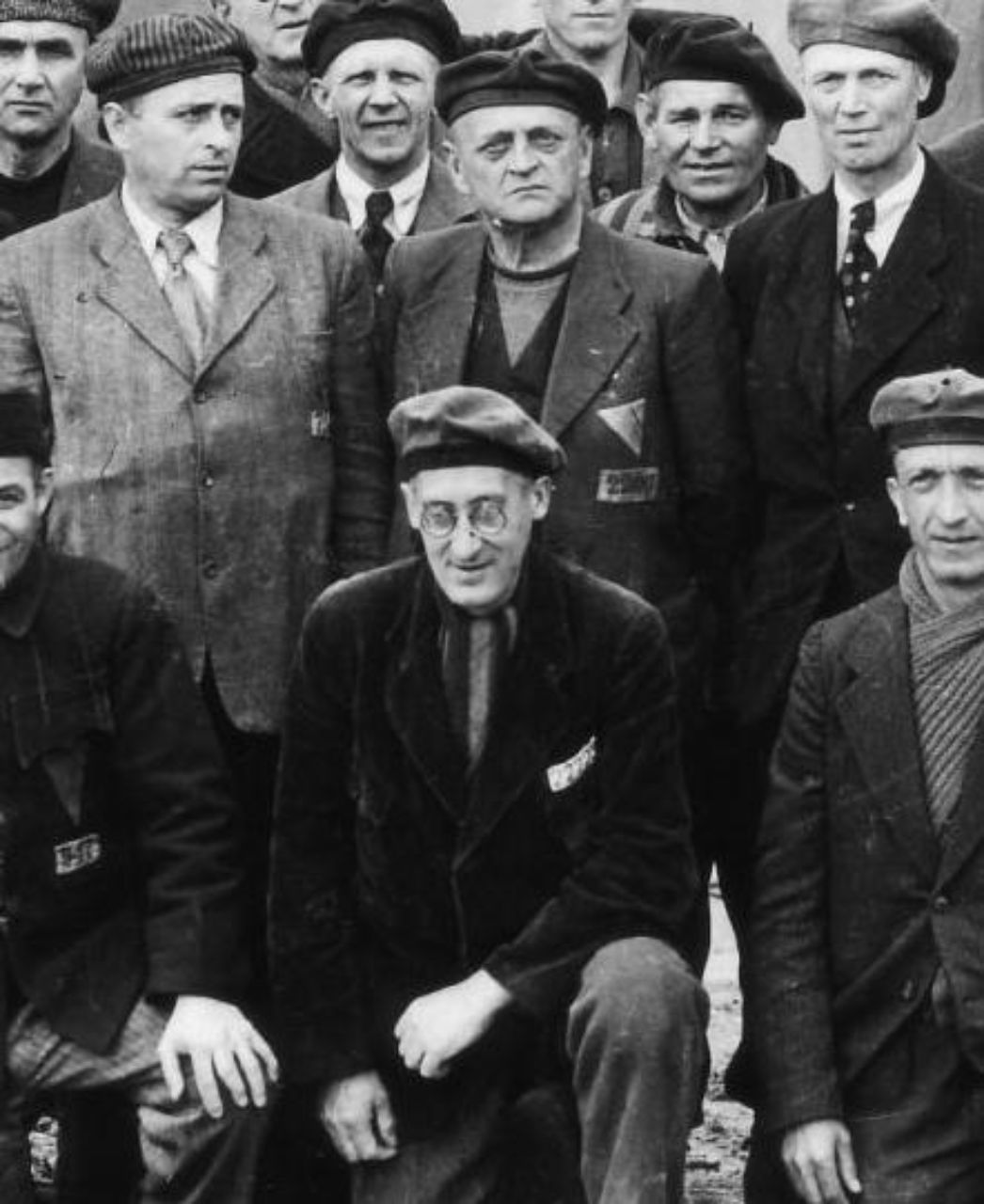
At this point, Alois Kasperkowitz is seriously ill. He is almost completely deaf in both ears, has extremely poor eyesight, and is physically weakened. In a concentration camp, this usually meant a quick end. Yet there is much to suggest that his fellow believers, who had been imprisoned for many years, helped him survive. He is given a disability armband and assigned to the camp work detail responsible for cleaning streets and paths. He remains there until the camp is liberated. The photo, taken in late April 1945, shows him surrounded by other Jehovah’s Witnesses. He returns to Austria with them in the summer of 1945. He lives to be 79 years old.