
Transcript
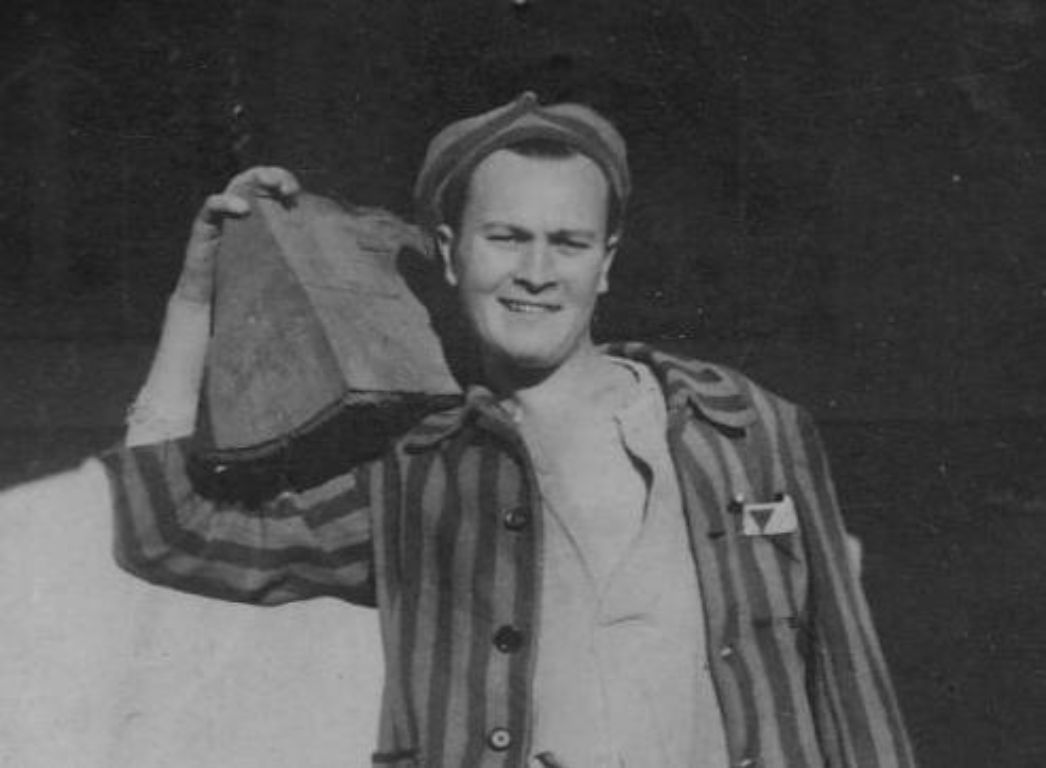
Narrator In January 1945, Red Army troops advanced into Upper Silesia. At the Laband labor camp near Gleiwitz, the young Belgian Charles Brusselairs heard the sound of gunfire growing louder and louder.
Suddenly, the front line is very close; the guards urge the prisoners to hurry: they are to leave the camp as quickly as possible. In -15°C weather, they trudge through deep snow for days on end. Charles recalls:
Charles Brusselairs “We were dying of hunger and cold. Our blankets and uniforms, soaked through by melted snow, were frozen to our bodies. Most of us no longer had shoes. Some had rags or pieces of blanket wrapped around their feet. Others were simply barefoot. […] Everything we had from Laband had been lost along the way.”
Narrator Shouts, orders, and gunshots accompany the march of thousands of exhausted prisoners heading west. Anyone who can no longer walk is shot. Over 100 prisoners from Laband die on the death march.
After the war, whenever it snows, Charles will repeatedly recall those terrible days, the cold, the hunger, and the exhaustion.
After ten days, they reach Neisse in Upper Silesia. From there, the Germans transport the prisoners in open freight cars via the Groß-Rosen concentration camp into the heart of the Reich. On February 5, 1945, they arrive at Buchenwald. They are housed as political prisoners in the Small Camp.
Charles is still a student when he joins the Belgian Resistance. His group gathers military intelligence, distributes leaflets, and helps people escape. Resistance activities are steadily increasing throughout Western Europe. In September 1941, Hitler decides to make the alleged perpetrators vanish without a trace—under “Night and Fog”—from the occupied territories. The sense of uncertainty is intended to intimidate the population.
At the end of June 1943, Charles is arrested and tortured. His parents receive no information when they inquire; they do not know where their son is or whether he is even still alive. As a so-called NN prisoner—short for “Night and Fog”—he is first sent to a penal camp in Esterwegen in the Emsland region, later to the Groß-Strehlitz prison in Upper Silesia, and finally on the death march to Buchenwald.
Shortly before American troops reach Weimar, the SS sends him on another evacuation transport: Over 4,600 prisoners are on the move for nearly a month; about half of them die on the odyssey, which ends on May 6, 1945, in Theresienstadt. But Charles survives:
Charles Brusselairs “The door of our car opened. I looked into the cheerful face of a man in an unfamiliar uniform. He asked me something in a language I didn’t understand. I replied in Russian: ‘Nje Ponimai’ [...] The man burst out laughing and then [said]: ‘War over, tomorrow Maman, Fräulein, Cognac.’ No one answered; we remained seated. After a few moments, [Alfons] Lambrechts […] next to me muttered: ‘Guys, this guy claims the war is over.’ Still no answer. We were as good as dead.”
Narrator Charles, too, is very weak. At the end of June 1945, he is flown via an American repatriation camp near Prague to a sanatorium in the Black Forest. He does not return home until April 11, 1946.
Charles Brusselairs marries and becomes the father of four sons. For many years, he serves as chairman of the Belgian Buchenwald Committee and receives numerous awards.