Opening Hours Practical Info What is where? Apps Public Tours further language offers Accessibility FAQ

Chronology

The name "Buchenwald" became synonymous with National Socialist crimes when the concentration camp was built on the Ettersberg near Weimar in 1937.

From 1945, the Soviets used the site for one of their special camps, and after 1950, the GDR built Germany's largest concentration camp memorial here. In 1990, Buchenwald was redesigned as a memorial and opened up for the remembrance of the fate of other groups of victims.
1937

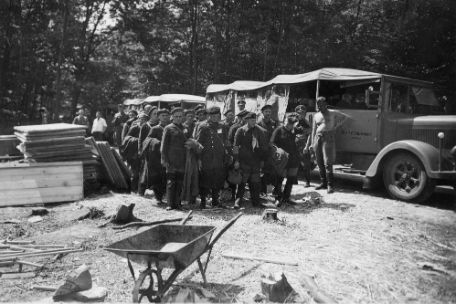
Prisoners lined up in rows of four stand amid tall trees. Next to them lie building materials and a wheelbarrow. In the background, SS guards stand in front of their personnel carriers.
15.7.1937

Establishment of the Camp

On the Ettersberg outside the city of Weimar, the SS had the Buchenwald concentration camp built starting in the summer of 1937. It replaced the smaller central German camps Lichtenburg, Sachsenburg and Bad Sulza.

Read more

1938

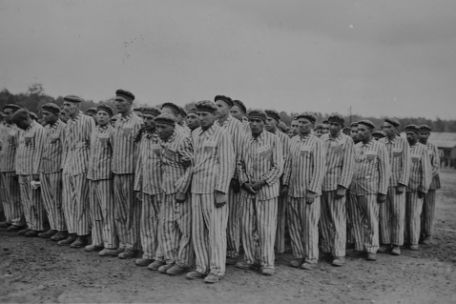
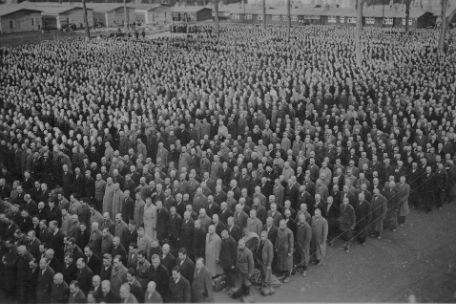
On the crowded Buchenwald roll call square, about a thousand men stand separately in groups of eight. They stand in rows in blocks of about five by 16, but between the blocks there are other people. In the background some barracks.
1938

Mass Arrests

The number of prisoners steadily increased over the course of 1938. As part of the "Arbeitsscheu Reich" (ARS) initiative— targeting "work-shy" persons in the German Reich—the police sent more than 4,000 men to the Buchenwald...

Read more

1939/1940

In Reih und Glied stehende Häftlinge alle tragen sie die gleiche Zebrastreifen Häftlingskleidung und Mütze. Einige zeigen eine gerkümmte Körperhaltung oder schmerzverzerrte Gesichtsausdrücke.
1939/40

War and Crime

With the war, the number of prisoners increased again. Around 8,500 men, among them Roma from Burgenland as well as Czechs for the first time, thousands of Poles and Jews from Vienna, arrived in Buchenwald in the weeks after the war began.

Read more

1941

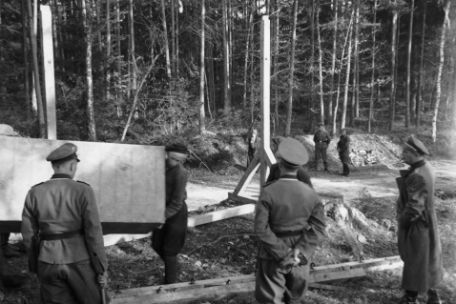
In the foreground are three men in SS uniforms, in front of them others carry wooden individual parts to two erected posts, which can already be recognized as gallows in the structure.
1941

Crimes and Cooperation

From 1941 onward, the SS murdered entire groups of inmates in an organized manner. In conjunction with the "Action 14f13" campaign, a total of 571 sick and incapacitated inmates were murdered at the "euthanasia" killing centres of...

Read more

1942

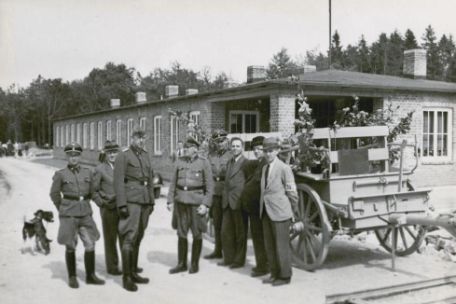
Camp commander Pister (center) and SS men with factory managers of the armaments factory. The men stand in front of a team of horses. In the background a bungalow.
1942

A Camp for the War Economy

Beginning in 1943, the SS geared the operation of the concentration camp more intensively towards the interests of the German war economy. For this purpose, there was a change in the camp leadership.

Read more
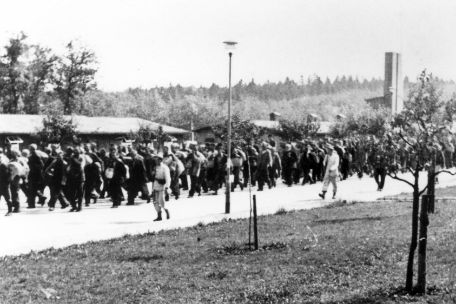
Packed prisoners are walking on a road. Around them, at intervals of a few meters, armed SS guards.
From 1942

Forced Labourers for the Ultimate Victory

With the use of inmates in the German arms industry came an increased demand for workers. A growing number of people from all over Europe were deported to Buchenwald to replenish the labour supply. Between the end of 1942 and autumn 1944, the number of...

Read more

1943

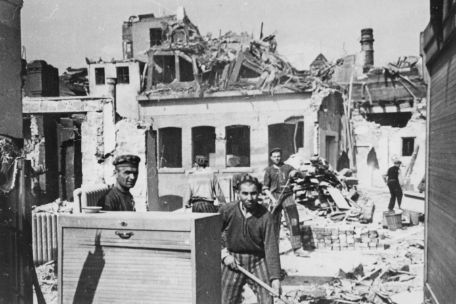
Four prisoners equipped with shovels and wheelbarrow work among house rubble
From 1943

Subcamps

By mid 1944, more than half of the inmates of the Buchenwald Concentration Camp were located in subcamps. Companies, towns, and departments of the government and military exploited their labour. Before 1942, only a few subcamps had been established, but...

Read more

1944/1945

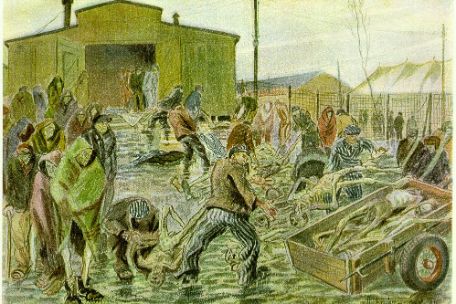
Drawing made in green and brown tones. In front of a barrack, prisoners dressed in rags pull an indeterminable number of emaciated, dead bodies from a pile onto a wheelbarrow. Other prisoners stand next to them and watch. A fence in the background separates the site from other barracks.
1944/45

The Final Months

The air strike on the armament factory at the camp and the SS complex on August 24, 1944, marked a turning point and the beginning of the final phase of the Buchenwald Concentration Camp.

Read more

1945

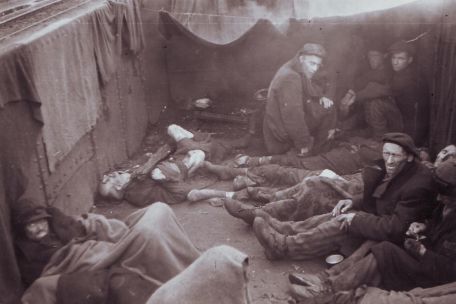
In an open freight car, a dozen starving prisoners lie and cower. Between them lies a deceased man.
1945

Death Marches

In early April 1945, more than 47,000 inmates were crammed into the main camp on Ettersberg Mountain. In conjunction with the advance of American troops, the SS had brought thousands of inmates from western subcamps back to Buchenwald.

Read more
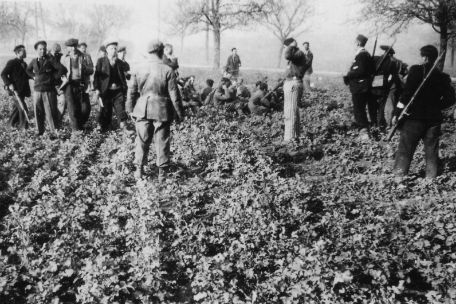
A dozen prisoners armed with rifles surround SS men sitting in a field
11.4.1945

Liberation

Beginning in the morning of April 11, 1945, armoured divisions of the Third U.S. Army advanced towards the east from the area near Gotha. At 10:00 am, all SS men were ordered to leave the camp. The International Camp Committee mobilized its resistance...

Read more
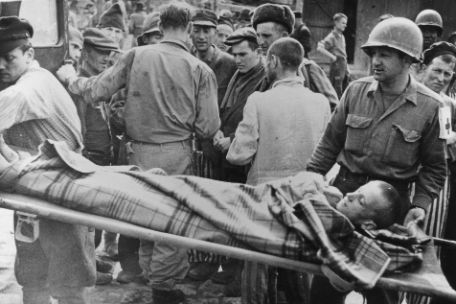
A man lying on a stretcher, wrapped in a blanket, is loaded into a van. A soldier with a medic's sign guides the stretcher. In the background are members of the U.S. Army and liberated prisoners.
April/May, 1945

After Liberation

Two days after liberation, the International Camp Committee passed control of the camp over to the U.S. Army. Despite emergency medical care, hundreds of former inmates died in the Displaced Persons Camp Buchenwald, as the camp was now called.

Read more
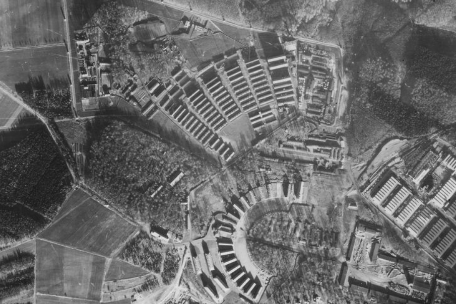
Aerial view of Buchenwald concentration camp from high altitude.
Buchenwald Concentration Camp

Facts and figures

400,000-m² prisoner camp | 3,500 metres of electric barbed-wire fence | 139 satellite camps | 277,800 prisoners | 30,000 minors | 28,230 women | 249,570 men | from more than 50 countries ...

Read more

1945

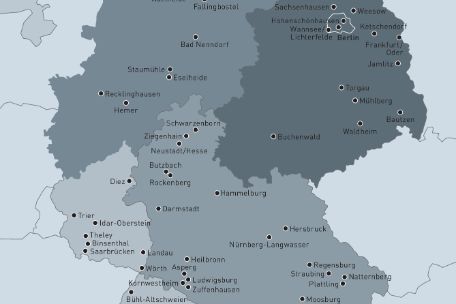
Map of the Allied internment camps in the four occupation zones
1945

End of the War and Allied Internments

With the surrender of the German Reich on May 8, 1945, World War II came to an end in Europe. Even while the war was still going on, the victorious powers agreed to the punishment of those responsible and means for providing security for the occupying...

Read more
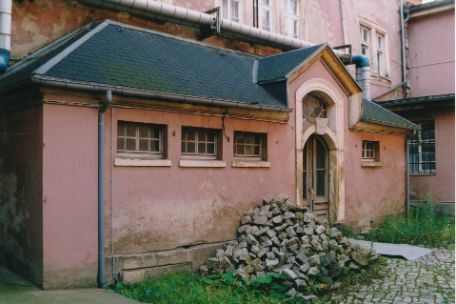
Frontal view of a small back building at Arnstadt town hall in the high grass in front of it are piled up cobblestones
Arrest Categories

Soviet Arrests and Internments

In January 1945, the Soviet Army reached the German Reich. The Soviet Minister of the Interior, Lavrentiy Beria, had the area behind the lines of advancing troop secured by means of arrests. A Beria order of 18 April 1945 established arrest categories.

Read more
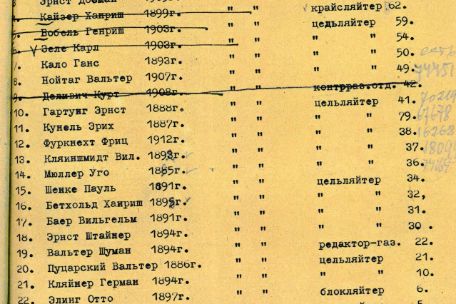
Twenty-five names are written one below the other in Cyrillic script. To the right are dates of birth some names are crossed out by hand.
A total of 28,494 people interned

Establishment of the Soviet Special Camp No. 2

The first transports to the Special Camp No. 2 arrived on August 21/22, 1945. These brought 46 detainees from Erfurt to Buchenwald. By the end of 1945, some 6,000 people from the region of Thuringia were held on Ettersberg Mountain.

Read more
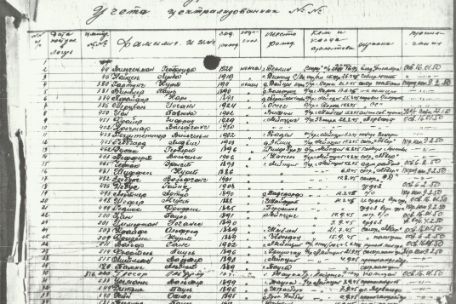
First page of the camp journal for the special camp. A handwritten, closely written table in Cyrillic script.
The Majority Are Men between 40 and 60 Years of Age

The Make-up of the Inmate's Society

Most of the men were between 40 and 60 years old, and over half of them had been local NSDAP functionaries (block and cell leaders). A number of them had been members of the police, Gestapo, or SS. In addition, numerous people were arrested who had not...

Read more

1946

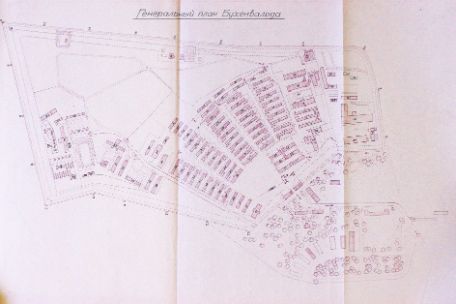
Plan of Special Camp No. 2. At the bottom right, the area of the former SS barracks arranged in a semicircle, but only part of it, forming a quarter circle, and the other functional buildings. Further to the center of the picture and occupying the whole remaining area, the prisoners' area with 6 longer rows of barracks and other buildings. At the top left are larger open areas. Outside around the camp fence with marked watchtowers.
Each of the Barracks Was Surrounded by a Fence

Layout of the Camp

Special Camp No. 2 was set up in a portion of the remaining buildings from the Buchenwald Concentration Camp. It did not make use of the crematorium, the Gustloff-Werke II, or the barracks of the Little Camp. A few new buildings were constructed.

Read more

1947

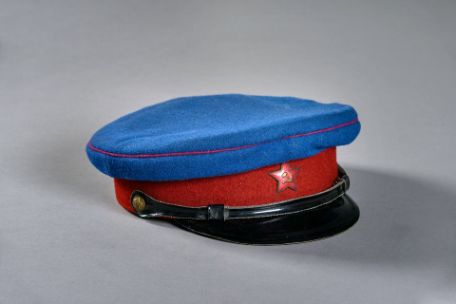
Blue and red officer's cap Cap of a NKVD captain. In front is a red star with sickle and mutton.
No More than 200 Soviet Soldiers

Administration and Custody

The administration of the camp was the responsibility of the NKVD/MVD. The first commander was captain Fyodor J. Matuskov. Major Konstantin P. Andrejev was put in charge in 1947. Members of the secret services (operative groups) were responsible for...

Read more
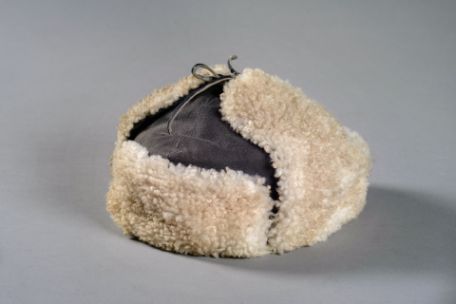
A bright fur hat with ears flipped up.
From Buchenwald to Karaganda

Transports to the Soviet Union

On 8 February 1947, the camp administration sent 1,086 internees from Buchenwald to the city of Karaganda in Kazakhstan, almost 5,000 kilometres away. There they were housed in prisoner-of-war camps.

Read more
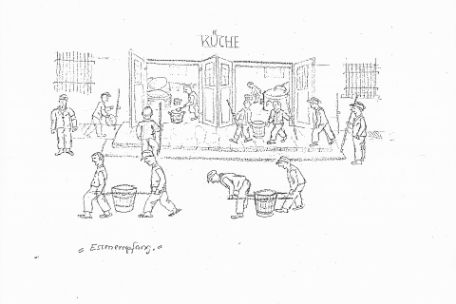
A drawing with the heading Kitchen. Behind open doors, people are working at troughs. In front of it, others carry open barrels in pairs.
Inadequate Provisions

Hunger and Disease

At the beginning of November 1946, the supply rations were cut to the lowest category of the non-working civilian population. A sharp increase in mortality was the result: more than half of the total number of people who died in Special Camp 2 died of...

Read more
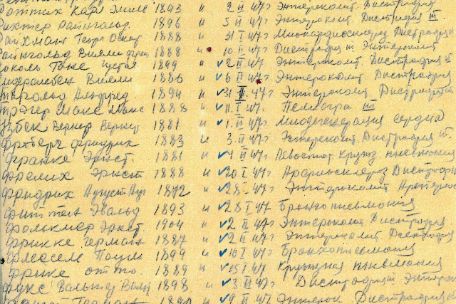
A yellowish paper with a handwritten table in Cyrillic script.
7,113 Dead

Death and the Treatment of the Dead

Between 1945 and 1950, 7,113 people died in Buchenwald, more than three quarters of them during the hunger winter of 1946/47. A burial detail buried the dead in two areas north of the camp. The relatives were not notified.

Read more

1950

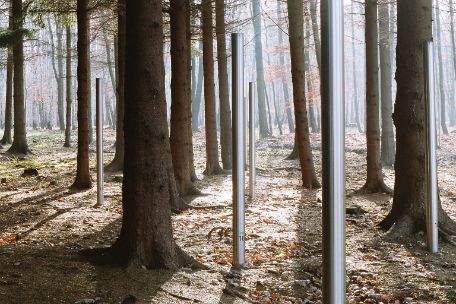
Brightly shining steel stelae in the forest cemetery mark anonymous collective graves from the time of the Soviet special camp
Before and after 1990

Taboo and Late Re-examination

Since 1990, the Buchenwald Memorial has been working on the previously taboo history of the Soviet special camp. Aspects of the camp's history were dealt with in discussion groups with former camp inmates.

Read more

1950

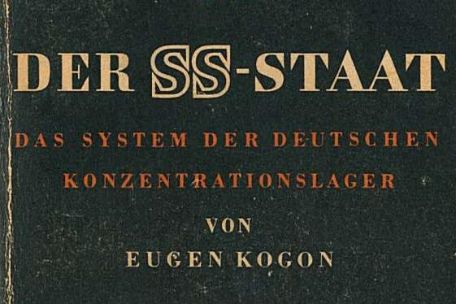
Book cover of Eugen Krogon's "Der SS-Staat-Das Systemb der Deutschen Konzentrationslager" The cover is black. At the top is the orange seal "The book series for everyone". Under the title is placed an orange isosceles triangle under which is the price of 2 marks.
After Liberation

Information is Collected and Organized

Since 1945, survivors' reports have made a significant contribution to the perception of the reality of Buchenwald concentration camp. Already in the first days after the liberation, more than 100 survivors, most of whom had held positions in the...

Read more
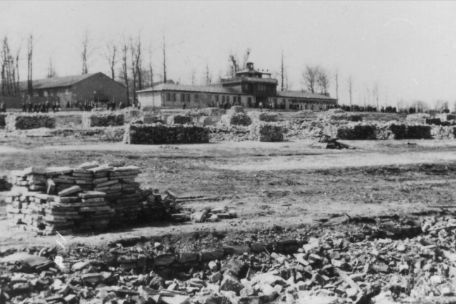
View of the gate building from the northeast. At the time the photo was taken, building material from the demolition of the wooden barracks is still on the camp site.
Early 1950s

Demolition of the Camp

In 1950, the Politburo of the SED decided only "to erect a Thälmann memorial" in Buchenwald. For Buchenwald, this meant that the entire camp with all its barracks was demolished.

Read more

1958

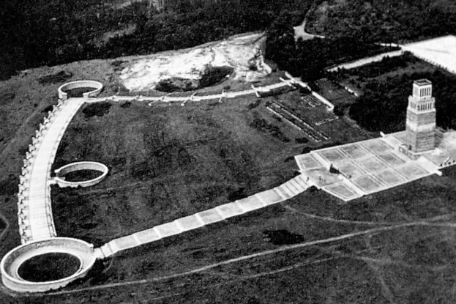
An aerial view of the newly erected memorial site on the Ettersberg. On the left are the three ring tombs and the Road of Nations. On the right, the bell tower of the complex on the Platz der Feiheit stands out.
1950s

Design of Mass Graves as a National Monument of the GDR

Simultaneously with the demolition of the camp, plans were made for the construction of the monumental memorial on the south side of the Ettersberg. It was inaugurated on September 14, 1958.

Read more

Nach 1958

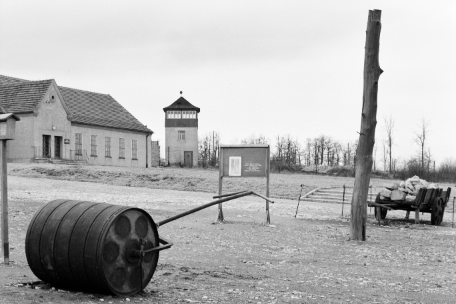
In the foreground, on the left side, is a hand leveler. A pile can be seen on the right. A little behind the pile is a cart loaded with quarry stones. In the center of the picture is a sign offering information to the visitor. In the left background, the entrance and right wing of the former prisoners' canteen can be seen. To the right is one of the watchtowers of the former camp.
1958-1989

Expansion of the Memorial

With the inauguration of the memorial in 1958, the central goals of commemoration at the Buchenwald National Memorial (NMG) were set. Until 1989, an ever more tightly meshed network of memory was laid over the historical site, allowing only those...

Read more

1991

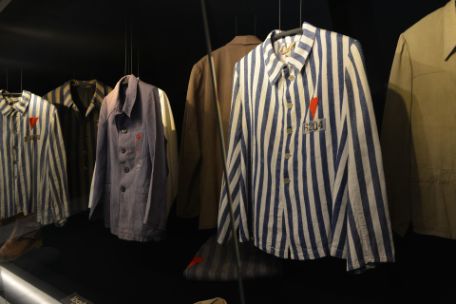
Six different tops of prisoners' clothing: Three of them blue and white striped, two olive and one dark blue. On the three in front there are red triangles on the top at chest level, with a number underneath.
After 1990

Re-conceptualization of the Memorial

In 1991, the Free State of Thuringia appointed an independent commission of historians to develop recommendations for the transformation of the Buchenwald NMG.

Read more

var _paq = window._paq = window._paq || []; /* tracker methods like "setCustomDimension" should be called before "trackPageView" */ _paq.push(['trackPageView']); _paq.push(['enableLinkTracking']); (function() { var u="https://matomo.buchenwald.de/"; _paq.push(['setTrackerUrl', u+'matomo.php']); _paq.push(['setSiteId', '1']); var d=document, g=d.createElement('script'), s=d.getElementsByTagName('script')[0]; g.async=true; g.src=u+'matomo.js'; s.parentNode.insertBefore(g,s); })();